Look at your dining table. Somewhere between the salt shaker and the napkin holder, there is likely a small vessel containing black gold. It is so ubiquitous, so ordinary, that we sprinkle it onto our eggs without a second thought.
But if you were to travel back in time just 500 years, that shaker would be worth a king’s ransom. It would be locked in a chest, guarded by armed men, and used to pay taxes, dowries, and rent.
This is the story of Piper nigrum—the Black Pepper—the spice that launched a thousand ships, discovered continents, and fundamentally changed the shape of our world, as if it was real black gold.
The Cradle of the King
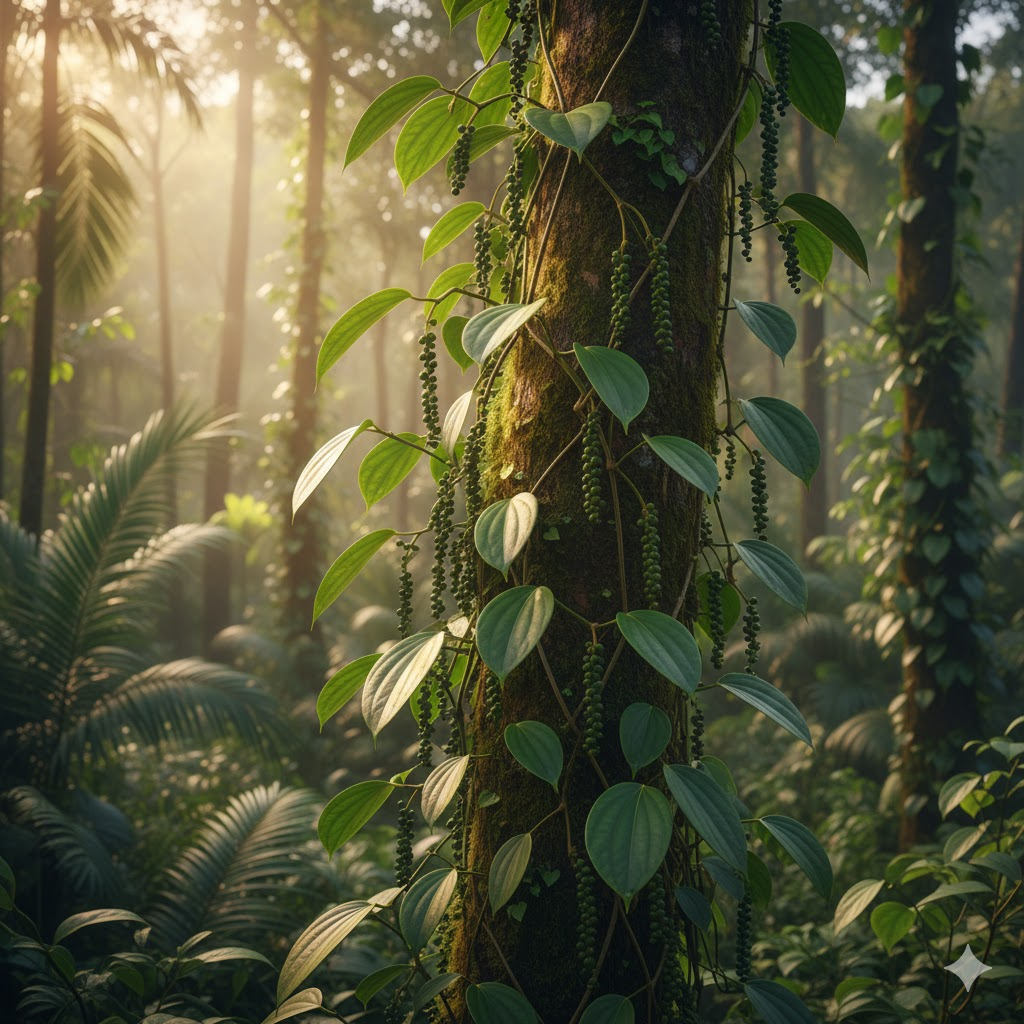
The story begins in the humid, monsoon-drenched hills of the Malabar Coast in Kerala, India. Here, amidst the lush greenery, vines climb high up the tropical trees, bearing clusters of small, green berries.
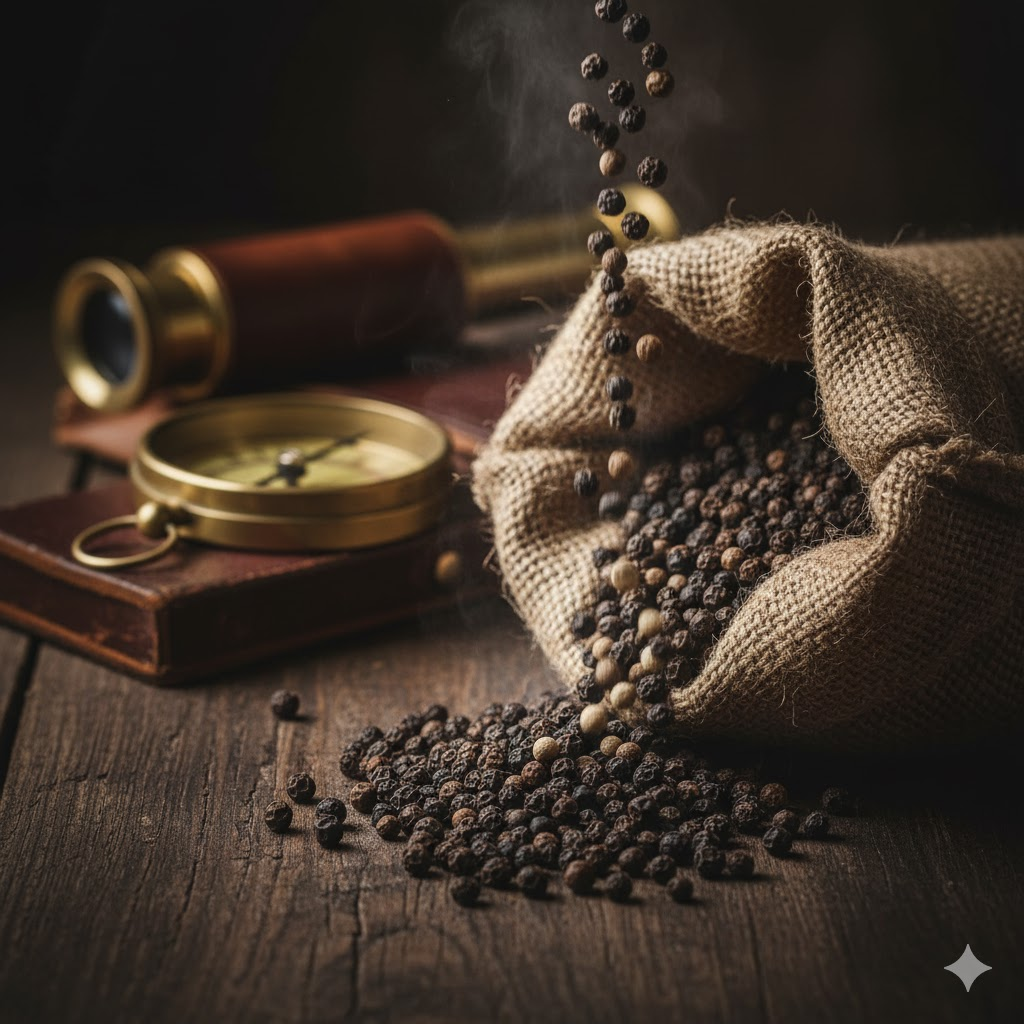
For millennia, this was the only place on Earth where the “Black gold” grew. The locals harvested the green berries and dried them under the scorching sun until the skin shriveled and turned black, locking in a pungent, fiery heat that was unlike anything the rest of the world had ever tasted.
While chili peppers (which give us spicy heat today) are native to the Americas and were unknown to the ancient world, black pepper was the original source of “heat” for European and Asian cuisines.
The Ransom of Rome
Long before the Middle Ages, the Romans were obsessed with pepper. It wasn’t just a seasoning; it was a status symbol. In the Roman cookbook Apicius, nearly every recipe calls for pepper. It was so valuable that it was often kept in special silver pots (piperatorium).
The value of this spice is best illustrated by a grim event in 410 AD. When Alaric the Visigoth besieged Rome, he didn’t just ask for gold or silver to spare the city. He demanded a ransom that included 3,000 pounds of black pepper, making black pepper as important as gold.
Think about that: a barbarian warlord, standing at the gates of the greatest empire in history, demanding dried berries as a tribute equal to gold, hence the name “black gold”. Rome paid the price, but the city fell shortly after. The empire collapsed, but the addiction to pepper remained.
The Arab Monopoly and the Dragon Myths
During the Middle Ages, the route from India to Europe was long, dangerous, and strictly controlled. Arab traders dominated the Indian Ocean, and the Venetians controlled the entry into Europe. Together, they held a stranglehold on the spice trade.
To keep the prices astronomically high and discourage competitors from trying to find the source, traders spun wild legends. They told gullible Europeans that pepper grew in groves guarded by venomous flying serpents (dragons). They claimed that to harvest the pepper, the farmers had to burn the trees to scare the snakes away, which was why the peppercorns were black and shriveled.
It was a brilliant marketing lie. It added an aura of danger and mystique to the spice, justifying prices that made pepper literally worth its weight in gold. “As dear as pepper” became a common expression to describe something prohibitively expensive.
The Race That Changed the World
By the 15th century, Europe was tired of paying the Venetian markup. The desire to bypass the middlemen and find a direct sea route to the “Spice Islands” sparked the Age of Discovery.
It is no exaggeration to say that the map of the modern world was drawn by the search for pepper (or black gold).
- Christopher Columbus sailed west in 1492 not to find America, but to find a shortcut to the pepper gardens of India. When he landed in the Caribbean, he found “aji” (chili) and called it “pepper” (red pepper) in a desperate attempt to convince his investors he had succeeded.
- Vasco da Gama successfully rounded the Cape of Good Hope in Africa and landed in Calicut, India, in 1498. When asked by the locals what he sought, his answer was simple: “Christians and spices.”
Da Gama returned to Portugal with a cargo of pepper worth 60 times the cost of his entire expedition. The price of pepper in Lisbon plummeted, breaking the Venetian monopoly and shifting the center of global power from the Mediterranean to the Atlantic. The global trade network had officially begun.
From Luxury to Commodity
Today, Vietnam has overtaken India as the world’s largest producer of black pepper (or black gold), followed by Brazil and Indonesia. Mechanized farming and global shipping have turned what was once a luxury item for emperors into a commodity found in every fast-food packet.
We grind it over salads and toss it into soups without realizing the history we are holding in our hands. We use it for its sharp bite, its ability to make strawberries taste sweeter or beef taste deeper.
But the next time you twist that grinder, take a moment to appreciate the journey. Those little black wrinkles are the reason ships sailed into the unknown, why continents were discovered, and why the world is connected the way it is today. You aren’t just seasoning your food; you are sprinkling a little bit of history onto your plate. If you want more, click here to discover how to master spices and herbs !

Leave a Reply