In a sun-scorched valley deep in the Americas, a tiny red fruit shimmers like a jewel, its glossy skin catching the light and promising a spark. That first heat, sudden and electric, rushes onto the tongue, a fierce whisper of sun, earth, and life. The aroma carries green sweetness entwined with smoky warmth, and in that moment you realize you are not just tasting a pepper, you are tasting history. This is chili, the fruit of fire, and its story unfolds like a global odyssey of flavor, culture, and heat.
Chili peppers, belonging to the genus Capsicum, have their roots in the Americas, particularly in regions around modern-day Mexico, Peru, and Bolivia. Archaeological evidence shows that humans began cultivating them at least 6,000 years ago, long before the invention of pottery in some areas. Researchers at the Smithsonian traced microscopic starch grains of domesticated chili peppers from ancient sites stretching from the Bahamas to southern Peru, revealing that chili was deeply woven into early agricultural societies. Other genetic and linguistic studies further localize the domestication of Capsicum annuum, the species that includes many of today’s most familiar chilies, to central-eastern Mexico.
Over millions of years, wild ancestors of chili diverged, and research suggests that all modern Capsicum species may trace back to a single progenitor that lived around 16 to 17 million years ago in South America. That deep evolutionary time is echoed in the diversity of shapes, colors, and pungencies that humankind now cultivates: mild bell peppers, sunlit cayennes, smoky chipotles, blazing habaneros, and the crisp, fruity Rocotos.
In the ancient Americas, chili was far more than a spicy snack. For the Mayans and Aztecs, the bright, burning fruit held ritual importance. They were used in cuisine, medicine, and even ceremony. The Aztecs called the pepper chīlli in their Nahuatl language, a name that still survives in the English word ‘chili.’ In some regions, chilies were valued as currency, traded over long distances, or used as a preservative to help food last in tropical heat.
When Europeans first encountered these fiery fruits, they were astonished. Christopher Columbus’s crew saw them in the Caribbean and brought them back to Europe, mistakenly calling them ‘peppers’ because their heat reminded them of black pepper, a prized spice of the Old World. From Spain, chili spread like wildfire, reaching Italy by the mid-1500s, Germany in 1543, and the Balkans by the end of the century.
In the Old World, chili peppers found new roles in kitchens and gardens. Portuguese and Spanish traders introduced them to Africa and Asia, where the fruits quickly became woven into regional cuisines. In India, where chiles now define the very soul of many regional dishes, some species like the fabled Naga Jolokia even emerged, varieties that, though cultivated and bred there, have ancestral roots in the Americas.
To trace chili’s cultural journey is to follow footprints spanning continents. In Latin America, chilies remain deeply embedded in traditional stews, salsas, and sauces. In Basque France, the Espelette pepper, Piment d’Espelette, has become a symbol of regional identity; its smoky, fruity warmth is protected by an appellation d’origine, planted and dried with care. In India, chili has become virtually inseparable from curries and pickles, and in Southeast Asia, bird’s eye chiles lend fierce fire to sambals and noodle soups.
Alongside the culinary migrations, scientific curiosity has illuminated chili’s hidden chemistry. The molecule responsible for its fiery sting is capsaicin, which binds to receptors in our mouths to trick us into perceiving heat. Modern studies reveal that chili peppers are rich in other bioactive compounds: antioxidants like vitamins C and E, and phytochemicals with anti-inflammatory and analgesic potential. Capsaicin also finds use outside the kitchen, it is used in topical pain relief creams, and some researchers even explore it for its potential to boost metabolism or serve as a natural preservative.
A culinary historian might reflect on chili’s global conquest with awe. ‘It is rare,’ one expert might say, ‘for such a small fruit to have shaped entire cuisines, economies, and cultures. That simple heat you feel is not just biology, it is a living thread from an ancient field in Mexico to your table today.’
Chili in modern Kitchens
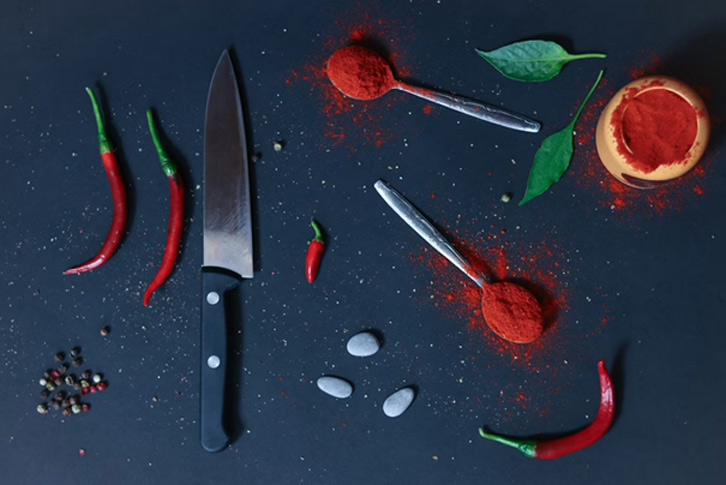
In modern kitchens, chili continues to evolve. Chefs experiment with fermented hot sauces, infused oils, and even chocolate-chili pairings. At home, gardeners grow unusual heirloom peppers, preserving diversity that stretches back through centuries. Meanwhile, breeders and scientists carefully map the genomes of wild and domesticated Capsicum, seeking resilient strains that can withstand climate change while preserving flavor.
But the story of chili is not only one of utility or science; it is infused with emotion. For many, biting into a spicy pepper conjures memory, of summer barbecues, of family gatherings, of a tongue tingled and alive. That simple spark connects us to ancient agriculturalists who tended fields millennia ago, to travelers who carried seed across oceans, to modern cooks shaping new forms of fire and flavor.
As the sun dips on a garden of glowing fruits, reds, yellows, purples, the air thick with warmth and promise, one realizes that chili is more than a spice. It is a journey: from wild Andes forests and Mesoamerican fields, through clashing empires and sea routes, into every corner of global gastronomy. The heat is its signature, but the legacy is its true gift.
When you next taste that vibrant burn, pause for a moment. Feel the heat pulse, the flavor deepen. Know that in that small fruit lives a story as fierce, rich, and alive as the fire it delivers.


Leave a Reply