We’ve journeyed through the ancient histories of salt and pepper, delved into the aromatic mysteries of cinnamon, and celebrated their starring roles in iconic dishes. But what happens when these culinary companions leave the kitchen and enter the realm of everyday language? When they shed their literal meanings and take on entirely new lives as metaphors, idioms, and slang?
It turns out our beloved spices are not just flavor enhancers; they’re linguistic shapeshifters, adding zest and color to our conversations, sometimes subtly, sometimes with a surprising kick. From describing emotions to indicating financial worth, salt, pepper, and other spices have infiltrated our vocabulary, proving their influence extends far beyond the plate.
“Worth Your Salt”: From Roman Rations to Worthy Contributions
Let’s start with our most fundamental seasoning: salt. As we learned, the word “salary” is derived from the Roman salarium, the payment given to soldiers to buy salt. This direct link to wages and essential value gave rise to the enduring idiom, “worth your salt.”
When we say someone “is worth their salt,” we mean they are competent, deserving of their pay, and contribute meaningfully to their job or task. Conversely, someone “not worth their salt” is considered lazy, ineffective, or unworthy of their position. This phrase perfectly encapsulates salt’s ancient status as a vital commodity, its presence equating to sustenance and value, its absence to deprivation and worthlessness. It’s a linguistic echo of a time when salt was literally currency, and proving your worth meant proving your ability to earn—and afford—this precious mineral.
Beyond the workplace, “salt of the earth” describes a person who is honest, humble, and fundamentally good. This evokes the purity and essential nature of salt, suggesting that such individuals are the unpretentious, grounding force of society. And, of course, the humorous notion of taking something “with a grain of salt” advises caution and skepticism, reminding us not to accept everything at face value, much like a tiny pinch can temper a strong flavor.

“Peppering” Your Speech: A Little Kick of Intensity
Black pepper, with its sharp, pungent kick, translates into language that suggests intensity, distribution, or even aggression.
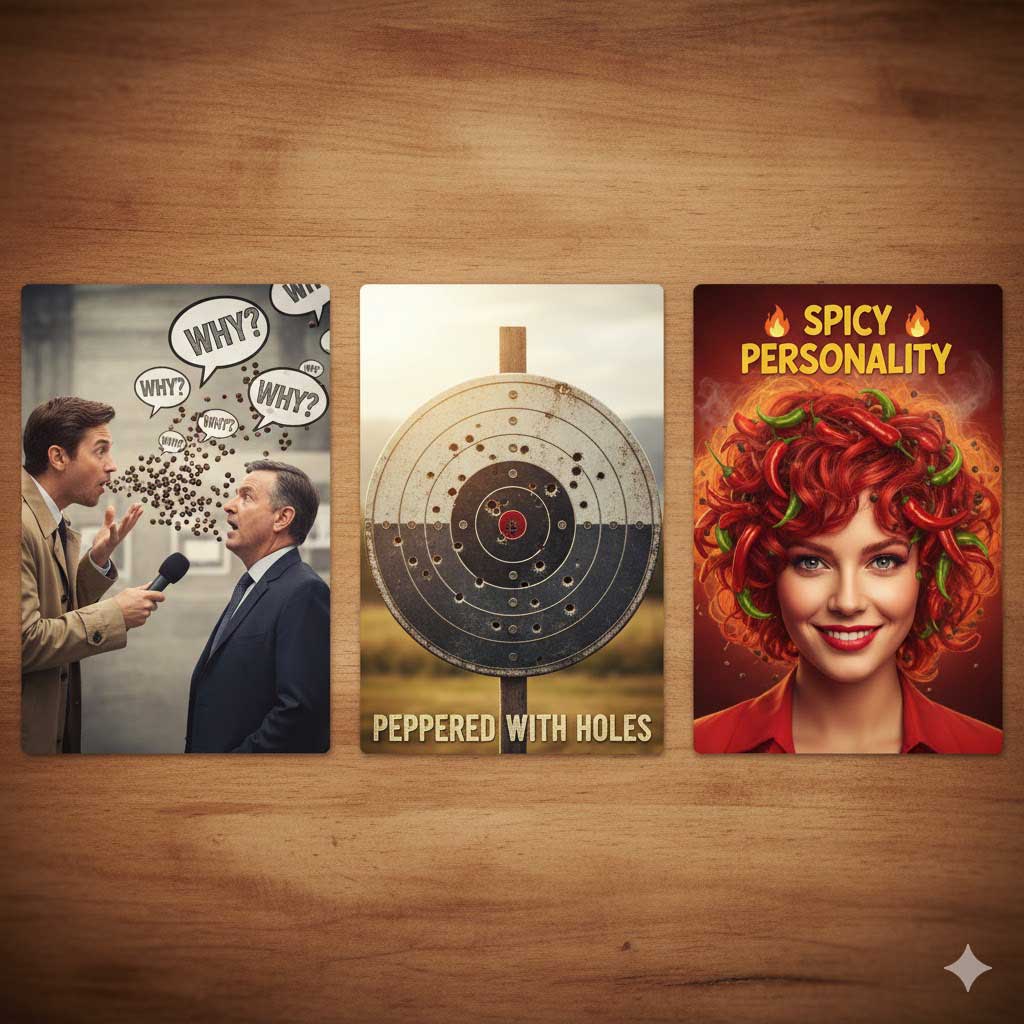
To “pepper” someone with questions, for example, means to ask them many rapid-fire questions, often in quick succession, much like a chef would rapidly grind pepper over a dish. It implies a concentrated, almost overwhelming barrage. Similarly, an object or surface might be “peppered with holes,” meaning it’s covered with many small holes, as if from a shot. This conveys a sense of thorough, widespread distribution.
While not as common, the phrase “hot as pepper” is a direct descriptor of high heat or temper, leveraging pepper’s inherent spiciness. In some older contexts, “pepper” could even be used to describe someone with a fiery personality or a sharp wit. The essence of pepper in language is always about adding a certain energetic punch, a distributed intensity, or a noticeable, often sharp, characteristic.
“Spicing Things Up”: Adding Excitement to Life
When we move to “spices” in general, the linguistic possibilities truly explode. The most common phrase, to “spice things up,” is universally understood as adding excitement, variety, or a thrill to an otherwise dull or routine situation. Whether it’s spicing up a relationship, a conversation, or a presentation, the analogy is clear: just as spices transform bland food into a vibrant feast, they can transform monotony into vibrancy.
This phrase beautifully captures the collective power of spices to stimulate the senses, ignite passion, and infuse life with flavor. It highlights their role not just as mere ingredients, but as catalysts for transformation.
We also have expressions like “variety is the spice of life,” emphasizing that diversity and change are what make existence interesting and enjoyable. This proverb recognizes spices as the embodiment of invigorating difference. Someone with a “spicy personality” is often seen as lively, bold, and perhaps a little bit mischievous or risqué, echoing the bold flavors and sometimes surprising heat of exotic spices.

Beyond the Usual Suspects: A Global Flavor of Words
Other individual spices also leave their mark on our language:
- Ginger: To have “ginger” or “ginger up” something means to add energy, liveliness, or enthusiasm. “Ginger ale” itself got its name from its invigorating, slightly spicy kick. A “ginger-haired” person has vibrant, fiery red hair, reminiscent of the root.
- Chilli/Chili: Beyond literal spiciness, “chili” can describe something intense, hot, or daring. A “chili recipe” for success suggests something bold and impactful.
- Vanilla: While a spice of incredible depth, “vanilla” in English slang often refers to something plain, unadventurous, or conventional, precisely because its flavor is so universally popular and non-threatening. To describe something as “vanilla” is to say it lacks excitement or edge. This is an ironic twist, given how complex and valuable real vanilla bean is!
From the foundational value of salt to the pungent punch of pepper and the collective zest of “spices” generally, these kitchen staples have seasoned our lexicon as much as they have seasoned our food. They provide vivid imagery and concise expressions that allow us to communicate nuances of character, situation, and emotion. The next time you reach for the salt shaker or a pepper mill, remember that you’re not just adding flavor to your meal; you’re engaging with a deep linguistic history where these everyday ingredients have always been, in one way or another, utterly priceless.
My other articles are listed here.


Leave a Reply