Category: Curry

  • The origins of curry: a journey through time, trade, and indian tradition

    https://en.wikipedia.org/wiki/Curry
    indian

    Few flavors in global cuisine are as instantly recognizable as curry. Aromatic, warm, and endlessly adaptable, curry is not a single spice but a rich, evolving blend with roots that reach deep into Indian and South Asian history. While today “curry powder” is found in home pantries and supermarket shelves around the world, its origins lie in ancient culinary traditions, dynamic trade networks, and centuries of cultural exchange. Understanding how curry came to be requires looking not only at its ingredients, but also at the civilizations that shaped (and were shaped by) this iconic blend.

    Ancient beginnings: the first spice blends

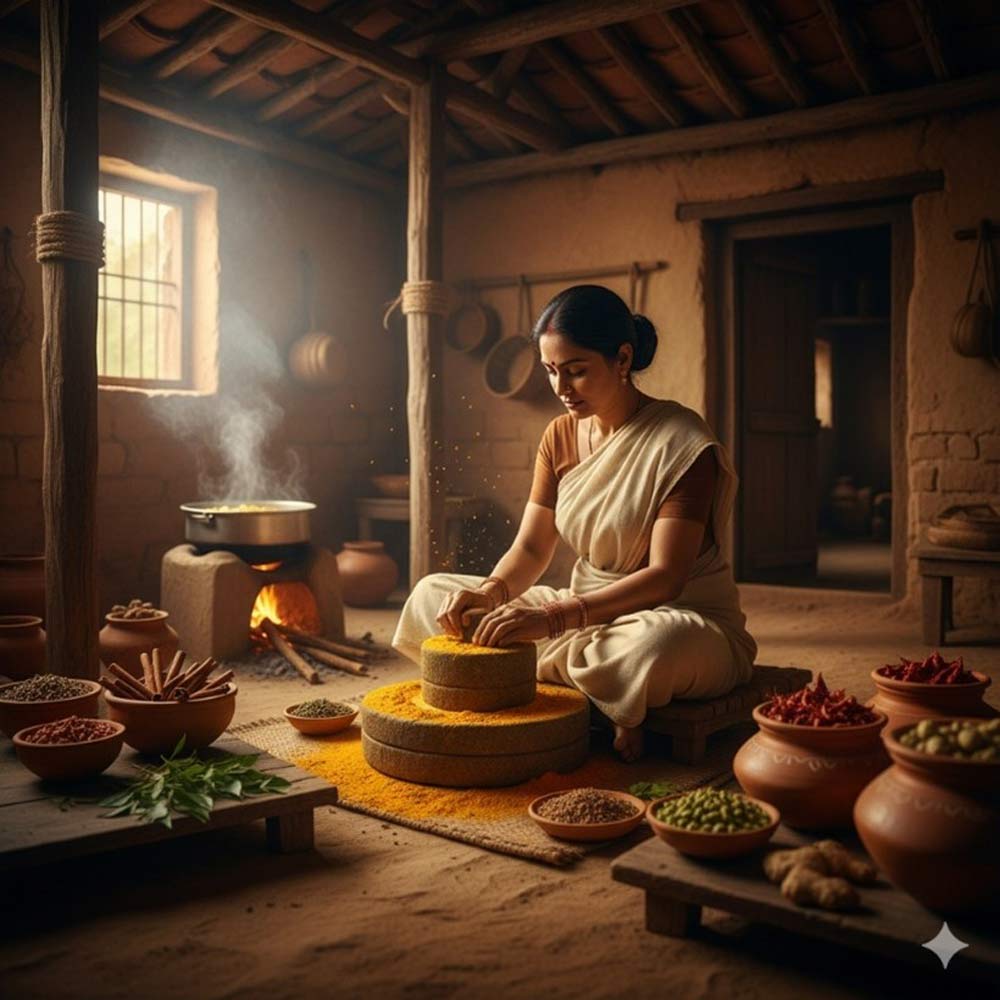
    The origins of curry date back thousands of years. Archaeological evidence from the Indus Valley Civilization (around 2500–1500 BCE) reveals that early South Asian cooks used combinations of spices such as turmeric, ginger, and garlic in their daily meals. Grinding stones discovered at sites like Harappa contain residues of these ingredients, suggesting that the ancestors of what we now call curry were already part of local culinary practices.

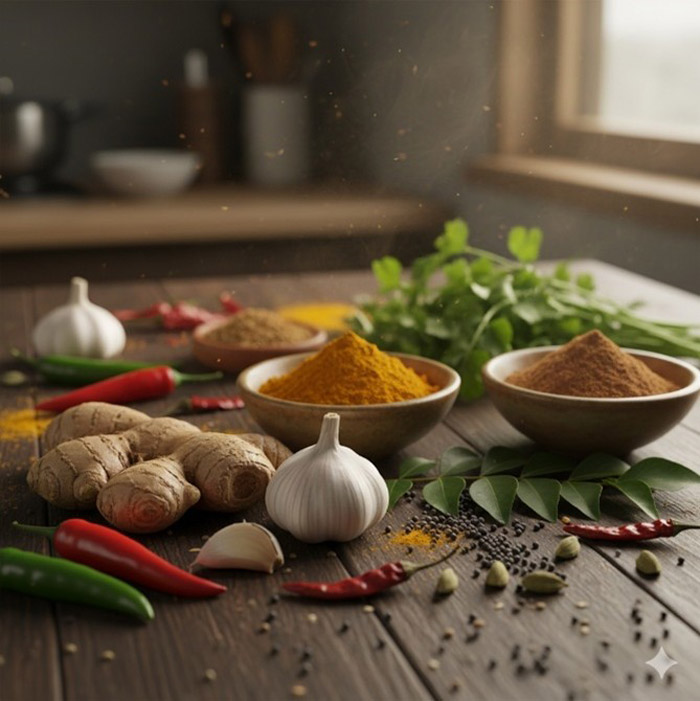
    These early blends were not standardized “recipes” but rather flexible mixtures built around fresh and dried spices. Turmeric provided earthy flavor and vibrant yellow color; cumin offered warmth; coriander added citrusy brightness. Over time, these combinations evolved regionally as cooks adapted them to climate, geography, and cultural preferences.

    Curry as a cultural practice

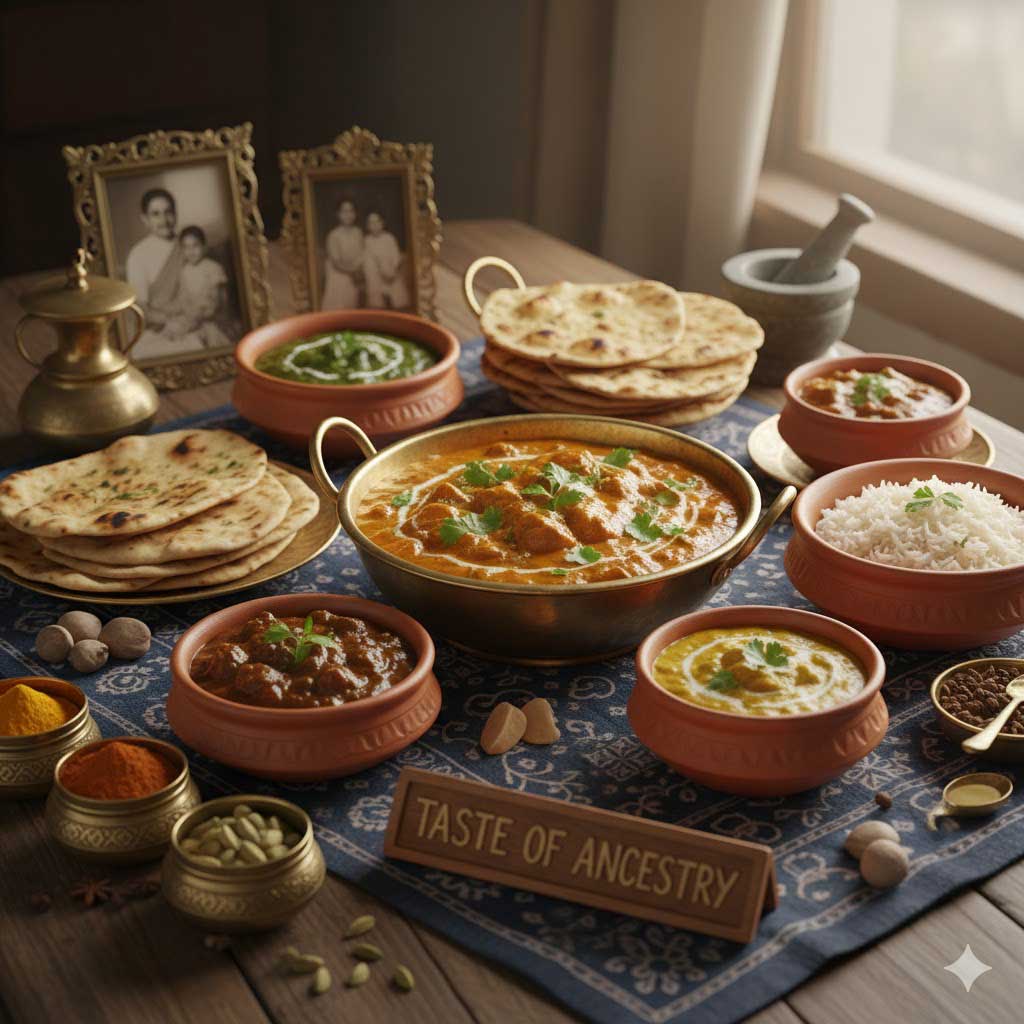
    In South Asia, curry is more than a spice mixture: it is a culinary philosophy. Traditional Indian cooking does not rely on pre-mixed curry powder; instead, families assemble masalas (spice blends) from scratch, adjusting flavor, heat, and aroma to the dish at hand. These masalas differ from region to region and even from household to household.

    For example:

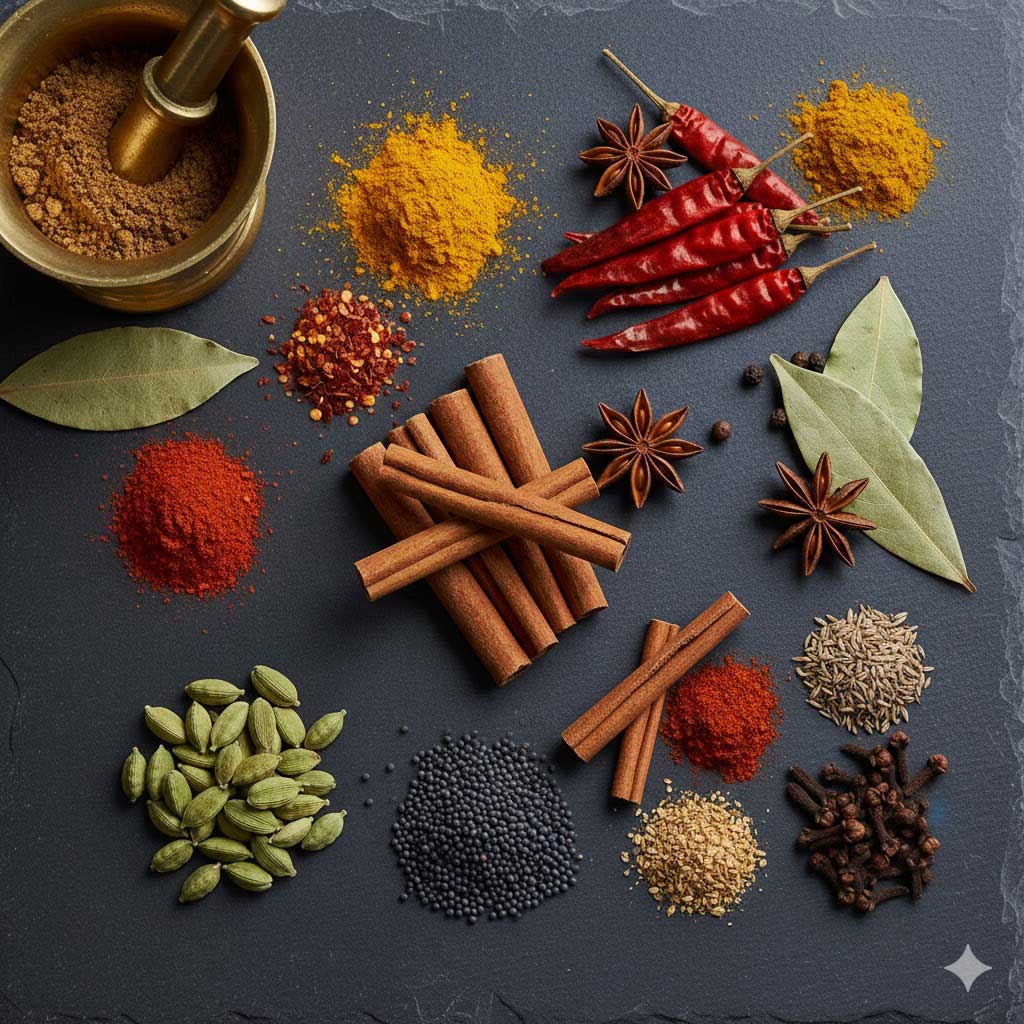
    • North Indian garam masala emphasizes warm spices like cinnamon, black cardamom, and cloves.
    • South Indian sambar powder relies heavily on lentils, fenugreek, chili, and curry leaves.
    • Bengali panch phoron uses whole seeds: fenugreek, fennel, cumin, black mustard, and nigella, fried in oil to release their fragrance.

    These variations reflect the complexity of India’s cultural and ecological landscape. As dynasties rose and fell, as traders arrived and departed, new ingredients flowed into the culinary repertoire, enriching the blends we now identify as curry.
    The influence of trade: a blend on the move

    By the 1st century CE, the Indian subcontinent had become a critical hub in global trade. Merchants from Arabia, Persia, Southeast Asia, and the Roman Empire traveled through the Indian Ocean in search of spices: pepper, cinnamon, cardamom, turmeric, and more. Many of these voyages passed through coastal regions where spice blends were a staple of everyday cooking.

    As traders encountered South Asian masalas, they brought back their aromatic principles to their own cuisines. The idea of flavoring stews with warm, fragrant spices spread through the Middle East and eventually into North Africa and Europe. However, the specific form known today as “curry powder” did not yet exist: it would emerge much later, shaped by colonial contact and Western reinterpretation.

    Colonial reinvention: the birth of curry powder

    The modern concept of curry powder is largely a British invention. When the British East India Company established political and commercial control in India in the 18th and 19th centuries, British officers, administrators, and merchants grew fond of Indian cuisine. Wanting to recreate these dishes back home, they searched for a convenient way to approximate the complex masalas used in Indian households.

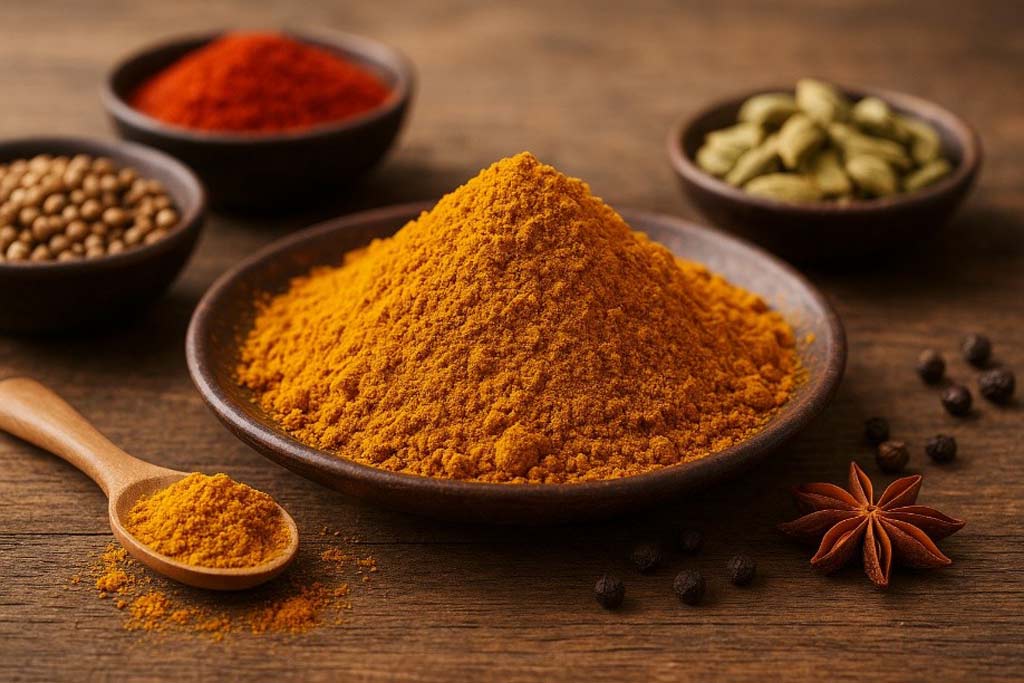
    Indian cooks prepared spice mixtures fresh, grinding ingredients daily based on experience rather than fixed quantities. This approach conflicted with the British desire for standardized, shelf-stable blends. In response, British traders began creating and exporting pre-mixed curry powders—typically containing turmeric, coriander, cumin, fenugreek, ginger, and chili.

    These early curry powders were not authentic representations of any single Indian masala. Instead, they were designed to capture the “essence” of Indian flavor as understood by European palates. Nevertheless, they became immensely popular, spreading rapidly throughout the British Empire and influencing cuisines in the Caribbean, East Africa, Southeast Asia, and even Japan.

    Curry across cultures: adaptation and evolution

    As curry powder traveled the world, it became a canvas for regional creativity.

    • In Japan, curry arrived in the late 19th century via the British Royal Navy. Japanese curry evolved into a mild, sweet, and thick stew often served with rice or breaded pork cutlets.
    • In the Caribbean, enslaved and indentured Indian laborers introduced their spice traditions. Over generations, curry fused with local ingredients, producing dishes like Jamaican curry goat and Trinidadian curry chicken.
    • In East Africa, Indian merchants brought curry spices to coastal cities such as Mombasa and Zanzibar, giving rise to Swahili curries infused with coconut milk and local herbs.

    This global diffusion demonstrates the extraordinary adaptability of curry as a culinary idea. Rather than remaining tied to a single tradition, curry adjusts to local tastes while preserving echoes of its South Asian origins.
    A living tradition

    Today, curry remains both a deeply traditional and constantly evolving element of global cuisine. While the Western concept of curry powder persists, many chefs and home cooks are returning to authentic masala preparation: dry-roasting spices, grinding fresh blends, and appreciating the artistry involved.

    Meanwhile, curry continues to inspire new interpretations: vegan curries, fusion curries, spice-infused cocktails, and even desserts. Yet at its core, curry remains rooted in ancient practices of spice blending, storytelling, and community.

    Conclusion: more than a spice blend

    The origins of curry reveal a history shaped by geography, trade, empire, and migration. What began as a regional spice tradition evolved into a global culinary phenomenon. Whether prepared as a simple home-cooked dal or a complex restaurant dish, curry embodies centuries of innovation and adaptation. It is a reminder that flavor is never static: it travels, transforms, and connects people across continents and generations.
    https://frogsaga.com/wp-admin/post.php?post=343&action=edit

  • Green Curry: The Vibrant, Flavorful Spice of Southeast Asia

    green curry

    Green curry, is one of the most aromatic and colorful staples in Southeast Asian cuisine. Often recognized by its bright green hue and creamy texture, green curry is more than just a sauce—it is a symphony of spices, herbs, and fresh ingredients that bring both heat and freshness to any dish.

    From traditional Thai kitchens to modern fusion restaurants worldwide, green curry has earned a reputation for its complex flavor profile and versatility. Let’s explore its origins, taste, culinary applications, and how to master it in your own cooking.

    Origin and History of Green Curry

    A Thai Classic

    Green curry originates from Thailand, where it is called “Kaeng Khiao Wan”, which translates to “sweet green curry.” The name comes from the vibrant green color of the curry paste, which is made from fresh green chilies, herbs, and spices.

    Historical Context

    Green curry is believed to have been developed during the reign of the Rattanakosin Kingdom (18th century). It evolved as a milder alternative to other traditional curries, incorporating fresh herbs and coconut milk for a balance of heat and creaminess. Over the centuries, green curry spread to neighboring countries, influencing Malaysian, Cambodian, and Vietnamese cuisines.

    Today, green curry is a global favorite, celebrated for its aromatic complexity and adaptable flavor.

    Flavor Profile of Green Curry

    This spice is known for its layered, vibrant flavor, combining several taste dimensions:

    • Spicy and tangy – from fresh green chilies and lime leaves
    • Herbaceous and aromatic – thanks to lemongrass, cilantro, and Thai basil
    • Slightly sweet – often from coconut milk
    • Umami depth – from fish sauce, shrimp paste, or soy sauce in some variations

    Its bright, fragrant character makes it both bold and balanced, appealing to a wide range of palates.

    Culinary Uses: How to Cook with Green Curry

    The Thai curry is extremely versatile and can be used with a variety of proteins, vegetables, and even tofu. Here are some practical applications:

    1. Classic Thai Green Curry Dishes

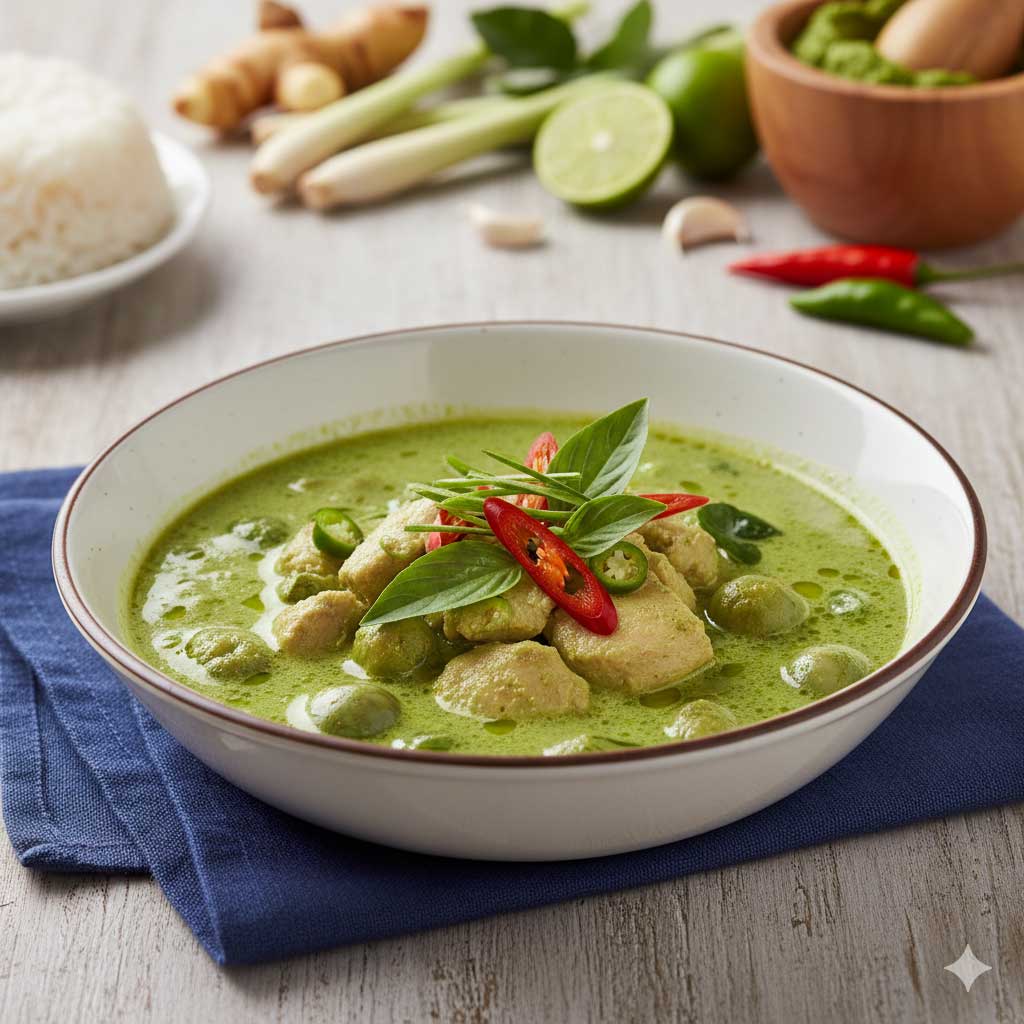
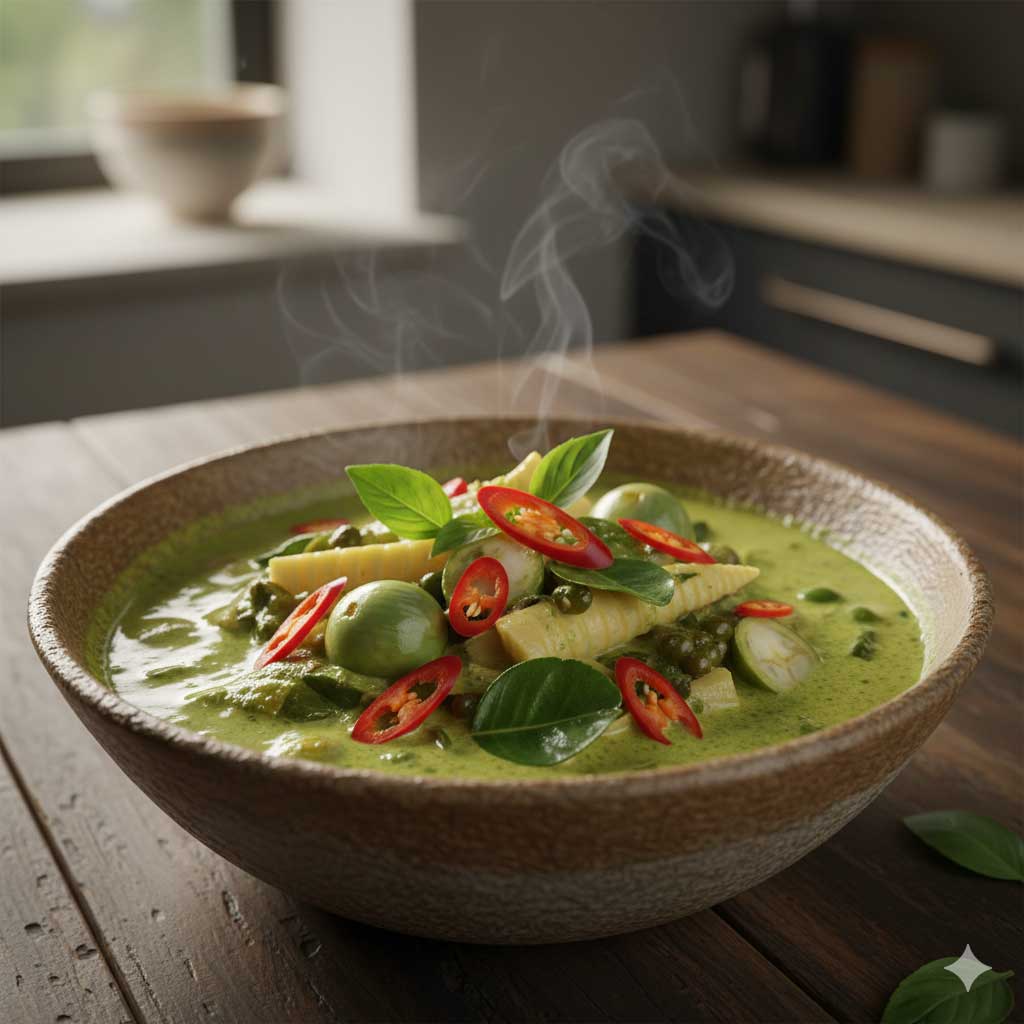
    • Chicken : Tender chicken simmered in green curry sauce with coconut milk, bamboo shoots, bell peppers, and Thai basil.
    • Beef or Pork : Slow-cooked with vegetables like eggplant, peas, and zucchini.
    • Seafood : Shrimp, fish, or squid in a light, spicy, and aromatic coconut curry.

    2. Vegetarian and Vegan Curry Dishes

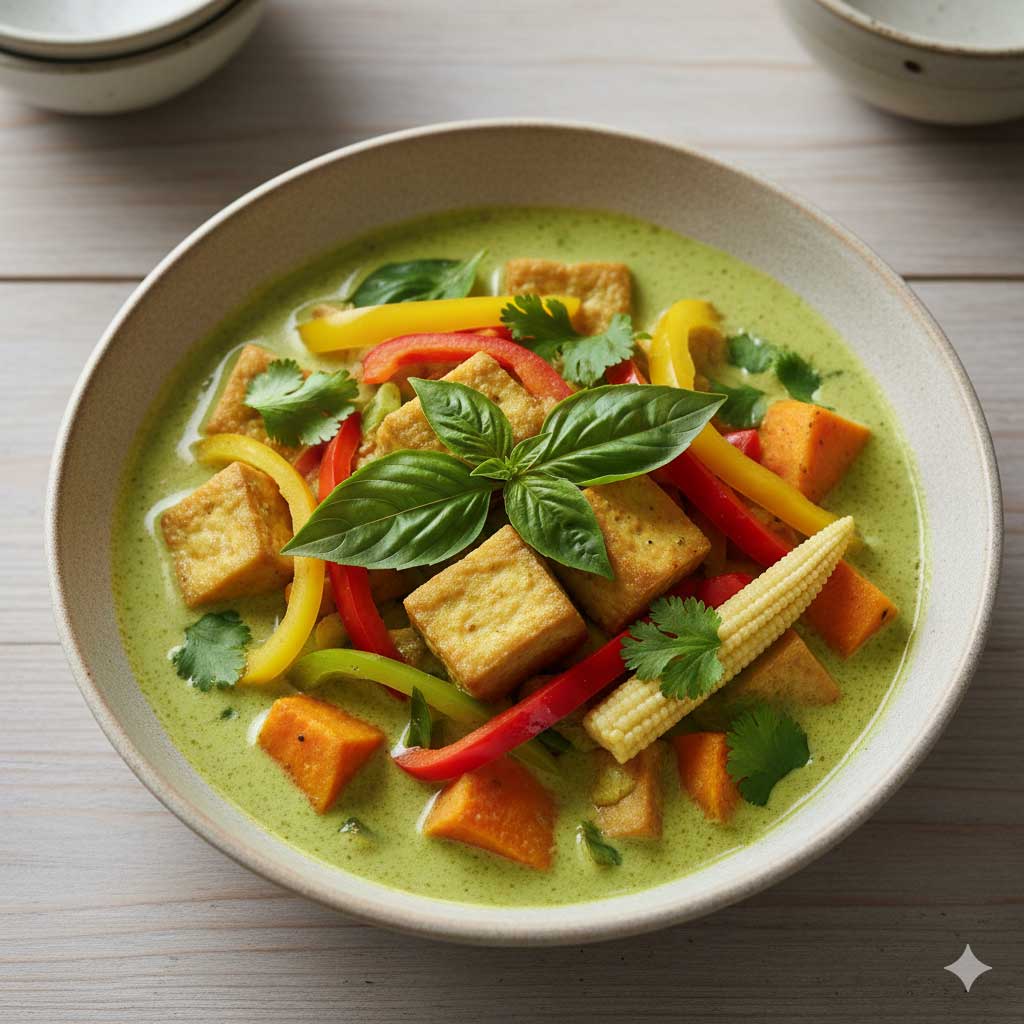
    • Tofu and Vegetable Curry: Firm tofu with green beans, bell peppers, carrots, baby corn, and snow peas.
    • Mushroom Medley Curry: Shiitake, oyster, and button mushrooms simmered with coconut milk and green curry paste.
    • Chickpea and Sweet Potato Curry: Chickpeas and cubed sweet potatoes cooked with green curry and coconut milk for a hearty, protein-rich meal.
    • Eggplant and Bamboo Shoot Curry: Soft-cooked eggplant and bamboo shoots in a creamy green curry sauce.
    • Mixed Vegetable Curry: Zucchini, bell peppers, carrots, broccoli, and snap peas for a colorful and nutrient-packed dish.
    • Pumpkin or Butternut Squash Curry: Sweet, roasted squash cubes added to green curry for natural sweetness and creamy texture.
    • Vegan “Seafood” Curry: Use king oyster mushrooms or hearts of palm to mimic seafood textures while keeping the dish plant-based.

    3. Creative Modern Uses

    • Stir into noodle soups for a fresh twist.
    • Use as a marinade for grilled vegetables or proteins.
    • Mix into rice or quinoa bowls for a flavorful, spicy kick.

    Health Benefits (General Knowledge)

    Green curry ingredients contribute to some general health benefits:

    • Chilies – contain capsaicin, which may support metabolism and provide antioxidant benefits.
    • Herbs like lemongrass and Thai basil – have anti-inflammatory and digestive properties.
    • Coconut milk – provides healthy fats that help absorb fat-soluble vitamins.
    • Vegetables and lean proteins – add fiber, vitamins, and minerals to the dish.

    While this spice is flavorful and nourishing, portion control is recommended due to coconut milk’s calorie density.

    Tips for Cooking with Green Curry

    1. Making Your Own Curry Paste

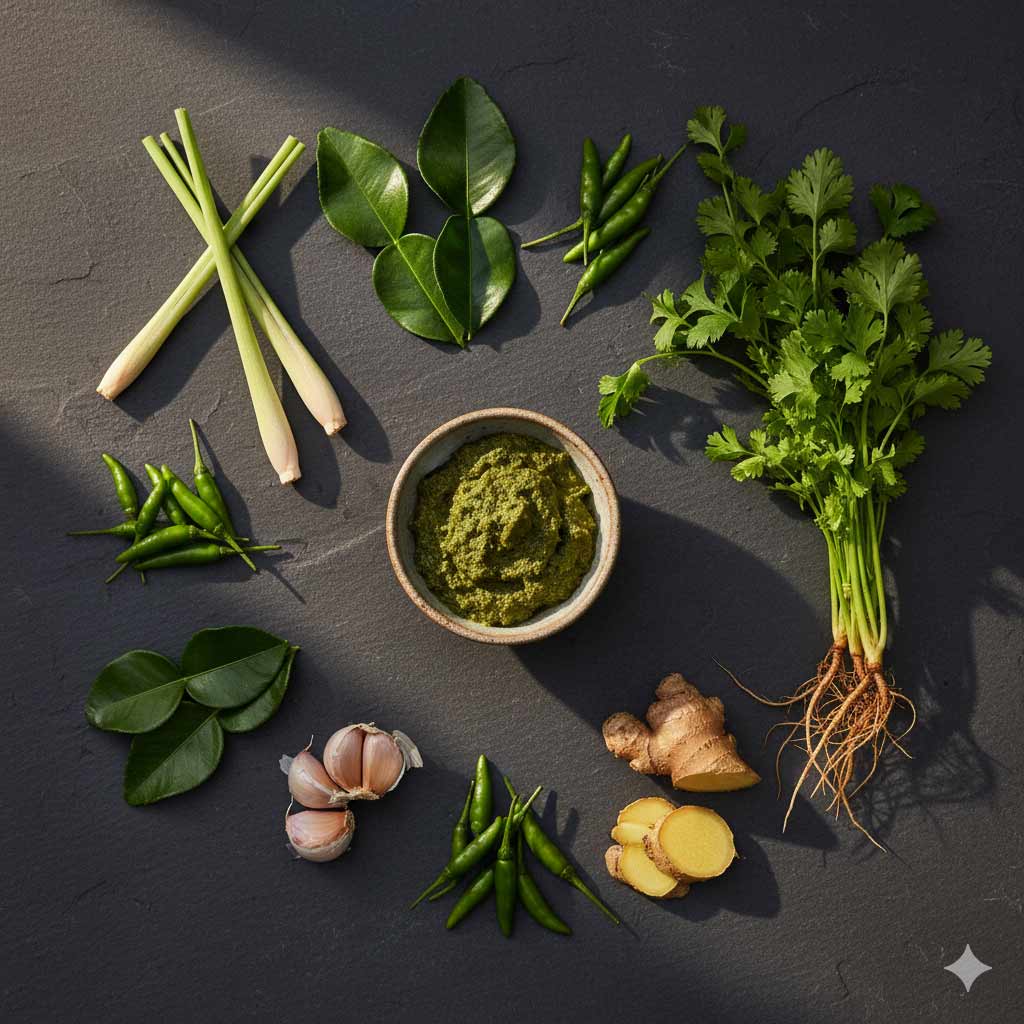
    • Use fresh green chilies, garlic, shallots, lemongrass, galangal, lime zest, and cilantro stems.
    • Blend with a mortar and pestle or food processor until smooth.
    • Homemade paste ensures vibrant flavor and freshness.

    2. Balance Heat and Creaminess

    • Start with a small amount of curry paste and gradually add to taste.
    • Coconut milk softens the heat and adds richness.
    • Lime juice or kaffir lime leaves add brightness and balance.

    3. Pair Wisely

    • Serve with jasmine rice or steamed rice noodles.
    • Garnish with fresh Thai basil, cilantro, or sliced red chili for visual appeal.
    • Avoid overcooking delicate vegetables; add them toward the end for texture.

    4. Storage Tips

    • Homemade green curry paste can be refrigerated for up to two weeks or frozen for up to three months.
    • Prepared curry dishes can be stored in airtight containers in the fridge for 2–3 days.

    Conclusion

    This spice is much more than a vibrant sauce; it’s a versatile, aromatic, and culturally rich spice blend that can elevate countless dishes. From traditional Thai chicken curry to modern vegetarian bowls, its bold, balanced flavors make it a beloved ingredient worldwide.

    Experiment with proteins, vegetables, and fresh herbs to create your own masterpieces. With a little practice and attention to balance, this spice can bring a delicious, fragrant, and slightly spicy touch to your everyday cooking.

  • The Great Worlds of Curry: Thai Curry

    Thai curry represents a completely different universe from its South Asian cousins. Where Indian curries rely heavily on powdered dry spices and a foundation of ghee or oil, and Japanese curries on a thick, dark roux, Thai curry are defined by their freshness, vibrancy, and the use of coconut milk. They are essentially soupy, fragrant stews built upon a base of wet, highly concentrated aromatic pastes, providing an unparalleled balance of salty, sweet, sour, and spicy notes—the four cornerstones of Thai cuisine.

    The true artistry of Thai curry lies not in the cooking process, but in the meticulous creation of the paste itself, traditionally pounded by hand in a mortar and pestle.

    The Triad of Thai Curry: Colour and Flavour

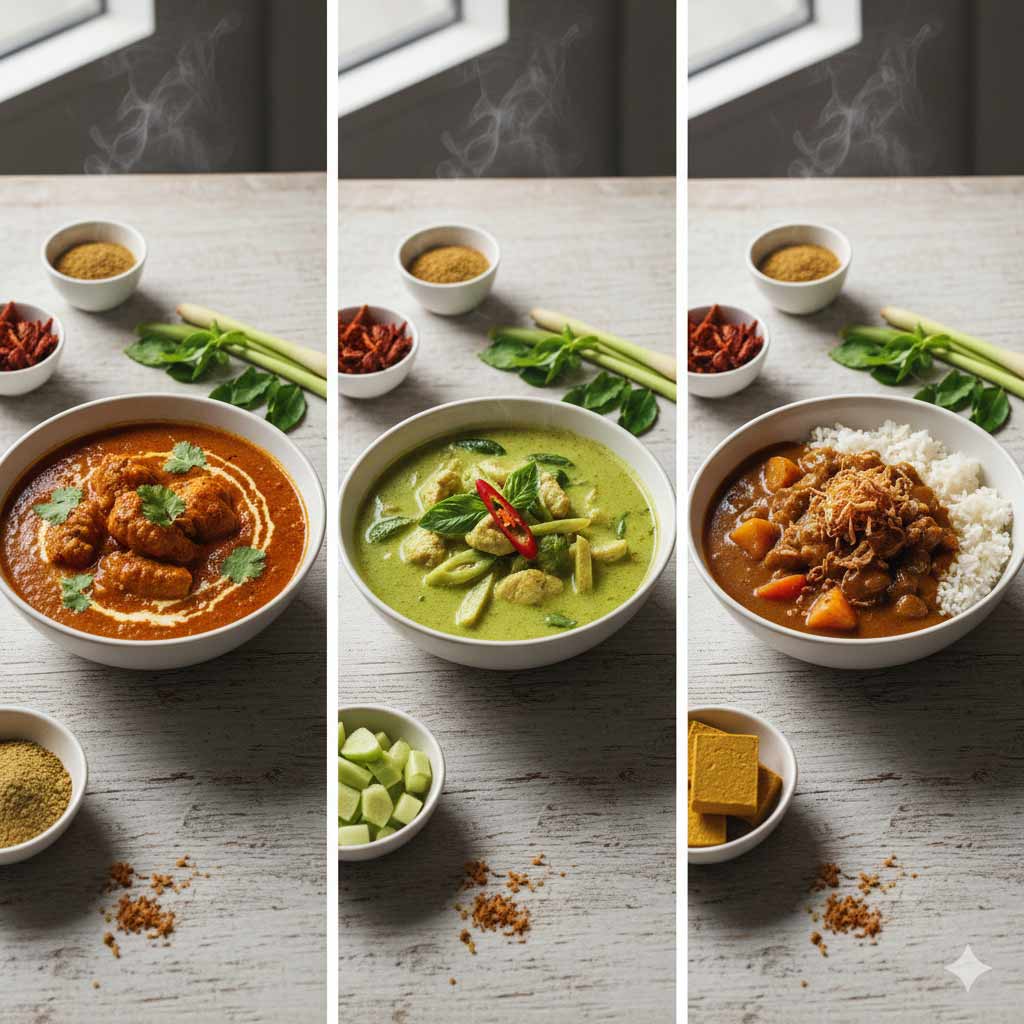
    Thai curry is primarily categorized by the colour of the paste used, which, in turn, dictates the heat level and main flavour profile. The three most common and distinctive types are Green, Red, and Yellow.

    1. Green Curry (Gaeng Keow Wan)

    • The Look: Named for the vibrant green of the fresh ingredients used.
    • The Paste: Generally the hottest of the three. Its characteristic colour comes from copious amounts of fresh green bird’s eye chilies, combined with lemongrass, galangal, kaffir lime zest and leaves, cilantro roots, and shallots.
    • The Flavour: Fresh, herbaceous, and intensely fragrant. The heat from the chilies is moderated by the sweetness of the coconut milk and sometimes a touch of palm sugar, creating a complex, well-rounded flavour. It is often served with chicken or fish and bamboo shoots.

    2. Red Curry (Gaeng Phet)

    • The Look: A fiery, reddish-orange colour.
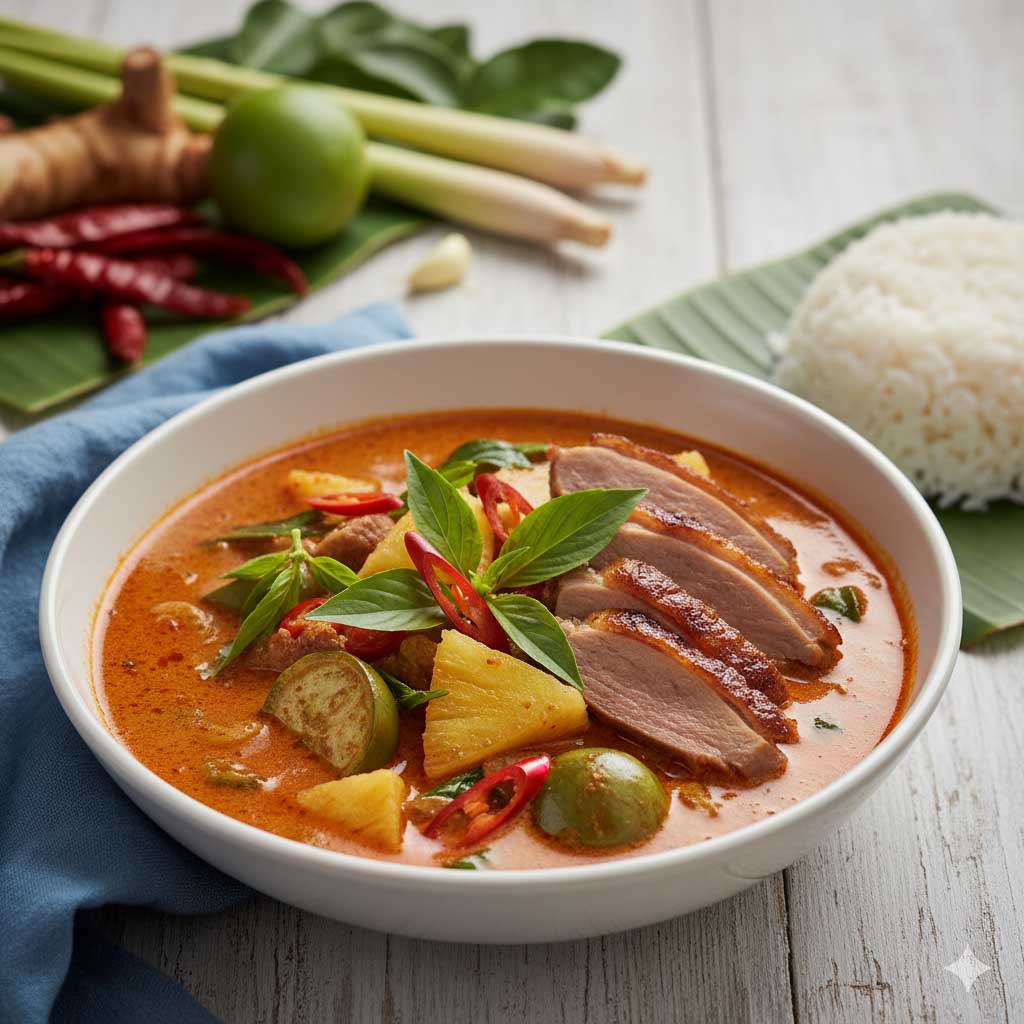
    • The Paste: The red comes from dried red spur chilies (which are less pungent than the fresh green ones, making the Red Curry often milder than the Green). The paste also features similar ingredients to the green curry, but the substitution of dried chilies for fresh ones changes the taste from herbaceous to earthy and robust.
    • The Flavour: Rich, slightly sweet, and earthy. It is extremely versatile and often used with duck, pork, or beef, and frequently includes vegetables like eggplant or pineapple.

    3. Yellow Curry (Gaeng Lueang or Gaeng Kari)

    • The Look: A mellow, golden-yellow hue.
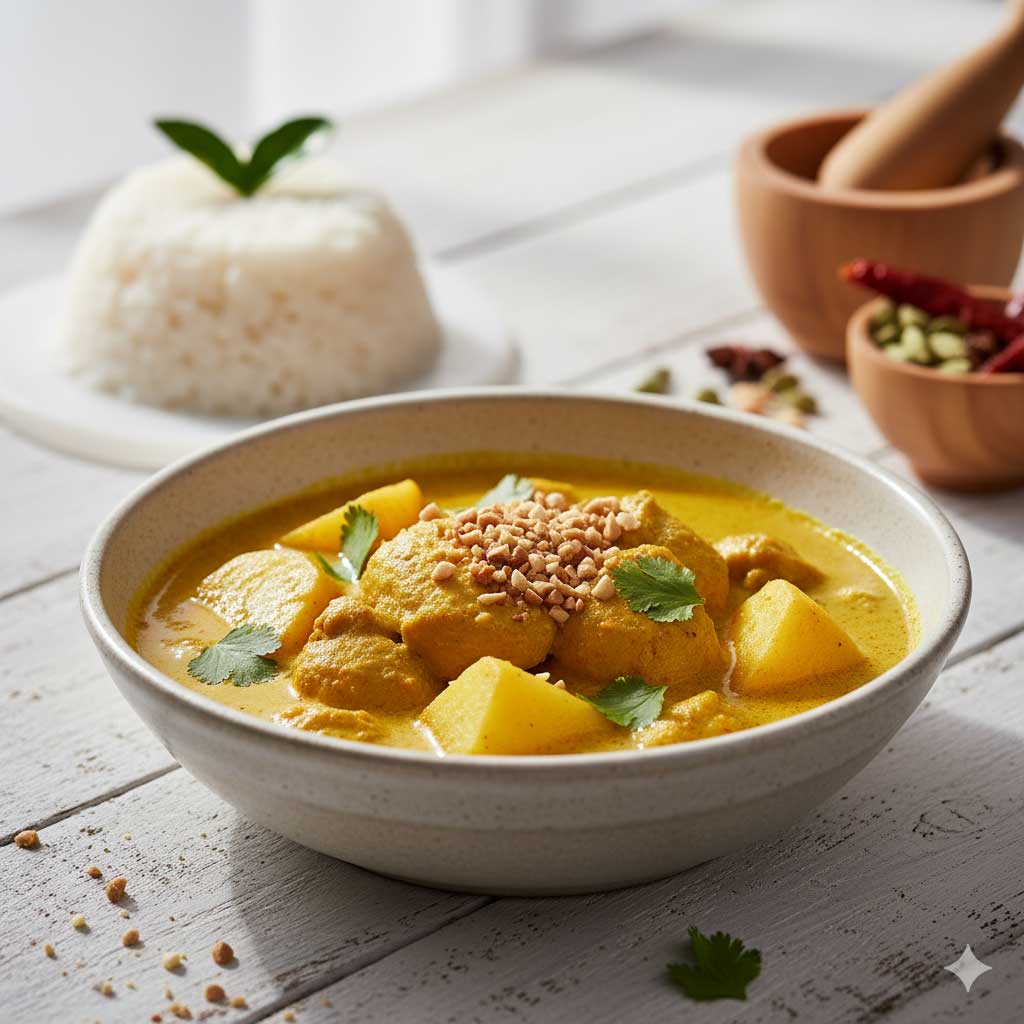
    • The Paste: Yellow curry is the closest in flavour to Indian curry, as it heavily features turmeric (giving it the yellow colour) and often includes a higher proportion of dry spices like cardamom, cinnamon, and sometimes Indian curry powder, reflecting its proximity to India and its trading history.
    • The Flavour: Mildest in heat and sweetest in taste. It is often served with potatoes and chicken and is particularly popular in the South of Thailand, where it is sometimes thickened further with peanuts.

    The Essential Role of Coconut Milk

    The ingredient that truly defines Thai curry is coconut milk. Unlike Indian curries, which often rely on water, stock, or yogurt, Thai curries use coconut milk as both the liquid base and the primary source of richness.

    The cooking method exploits the unique property of coconut milk:

    1. A small amount of coconut cream (the thick top layer) is simmered until the oil separates (a process called breaking the milk). This oil forms the base of the dish, toasting the curry paste and releasing its essential oils and fragrances.
    2. The paste is fried in this coconut oil, intensifying its flavour.
    3. The remaining coconut milk is added, creating the final, creamy, thin soup-like consistency.

    This process ensures that the spices are fully bloomed and the curry achieves a smooth, velvety texture that coats the rice perfectly.

    Regional Variations: Massaman and Panang

    Beyond the main triad, two other popular Thai curries demonstrate the diversity of the region:

    • Massaman Curry (Gaeng Massaman): This is a distinctly regional curry with Muslim and Indian influences. Its paste features dry spices not common in other Thai curries, such as cardamom, cloves, and cinnamon. It is sweet, tangy, and rich, often made with beef, potatoes, and peanuts, making it feel more like a rich, South Indian-style stew than a typical Thai curry.
    • Panang Curry (Gaeng Panang): Similar to red curry but significantly richer and thicker, often containing crushed peanuts. It’s drier and less soupy than other Thai curries and is renowned for its intense, savory-sweet flavour profile and the customary garnish of thinly sliced kaffir lime leaves.

    Thai curry’s philosophy is about contrast and harmony. The coolness of the coconut milk battles the heat of the chilies; the salinity of the fish sauce balances the sweetness of the palm sugar; and the sharpness of the kaffir lime cuts through the richness of the oil. This emphasis on fresh, pungent herbs and aromatics, rather than dried powders, places Thai cuisine in a distinct category, highlighting its connection to the region’s lush tropical environment. It is this masterful balancing act that has made Thai curry a global phenomenon, appealing to palates seeking a lighter, more aromatic, and ultimately, a more complex taste experience than its heavier, dry-spice-focused cousins.

  • The Great Worlds of Curry: French Curry

    When most people think of curry, their minds immediately travel to the vibrant street stalls of Delhi, the fragrant markets of Bangkok, or the comforting kitchens of Osaka. Yet, tucked away in the culinary history of Western Europe, a distinctive and often misunderstood variety exists: the French Curry. This is not a curry in the traditional sense, but a refined, colonial-era interpretation that showcases how French classical cuisine absorbed, translated, and ultimately elevated an exotic flavour profile for a European palate.

    The story of French curry is rooted in empire and trade. Long before the global movement of people brought authentic South Asian cuisine to Paris, spices like turmeric, ginger, and coriander found their way into French ports via maritime trade routes, particularly those connected to Pondicherry, a French colonial outpost in India, and the spice islands of the Caribbean and Indochina. Chefs in the 18th and 19th centuries, eager to introduce new, fashionable tastes to the aristocracy, began experimenting. However, lacking the deep culinary knowledge and specific ingredients of India, they developed a mild, elegant, and often creamy dish that bore only a passing resemblance to its origin.

    A Culinary Translation: From Spice Blend to Sauce

    The core difference between French curry and its South Asian counterparts lies in its structure and composition. Traditional Indian curries are built on a complex foundation of fried aromatics (onions, ginger, garlic) followed by a progression of powdered and whole spices, often culminating in a thin, broth-like consistency or a dry coating.

    The French curry is fundamentally different. It is primarily a sauce-based dish, derived from the foundational techniques of la haute cuisine. The typical French curry starts with a classic French roux—a mixture of butter and flour—to create a thick, stable base (either a Béchamel or a Velouté). To this white sauce, a pre-mixed, mild curry powder is added. This powder, often lighter in colour and lower in chili content than even mild Indian blends, provides the ‘curry’ flavour without the heat or the textural complexity of fried spices.

    This technique yields a sauce that is smooth, rich, and uniformly coloured—a far cry from the multi-layered, often oil-separated (called tarka or tadka) textures prized in Indian cooking. The French focus is on integration and refinement: every element must be homogenous and subtle.

    Key Ingredients and Execution

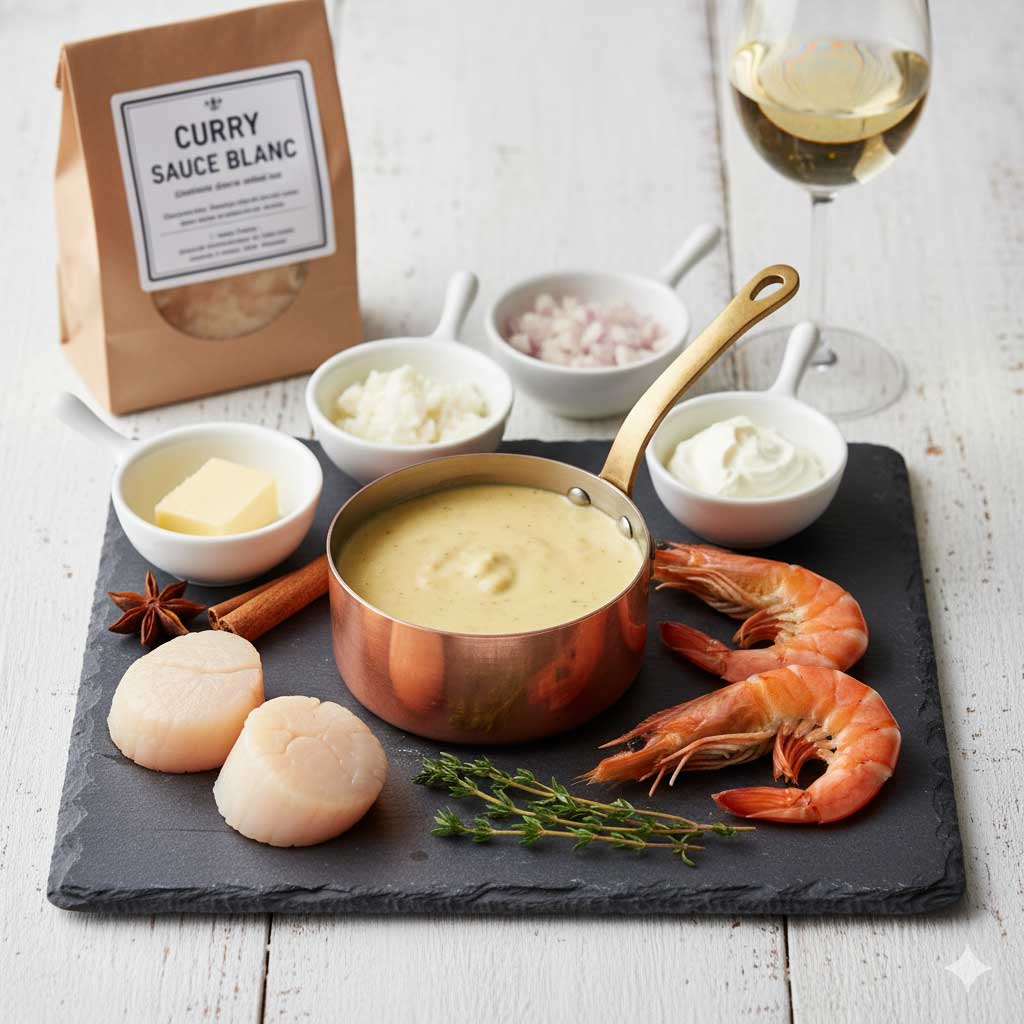
    A defining feature of the classic French curry is its pairing with seafood, particularly shellfish. The mild, creamy sauce is considered the perfect partner for delicate flavours like lobster (Homard au Curry), scallops (Coquilles Saint-Jacques au Curry), or prawns. The gentle, aromatic powder highlights the sweetness of the seafood without overpowering it.

    Essential components typically include:

    • The Base: A butter-rich roux and a dairy element (crème fraîche, cream, or milk) to create the Velouté or Béchamel.
    • The Flavouring: A mild, pre-packaged curry powder, which may include turmeric, coriander, and cumin, but often lacks fenugreek, mustard seed, or the aggressive heat of chili peppers.
    • Aromatics: Unlike Indian curries, the aromatics are often limited to shallots or white onions, sautéed gently (not browned) to maintain the sauce’s pale colour and delicate flavour.
    • Acid/Sweetener: A touch of acid, such as white wine or a squeeze of lemon juice, might be used to cut through the richness, while occasionally, a hint of apple or fruit chutney (again, a colonial import) is incorporated for sweetness.

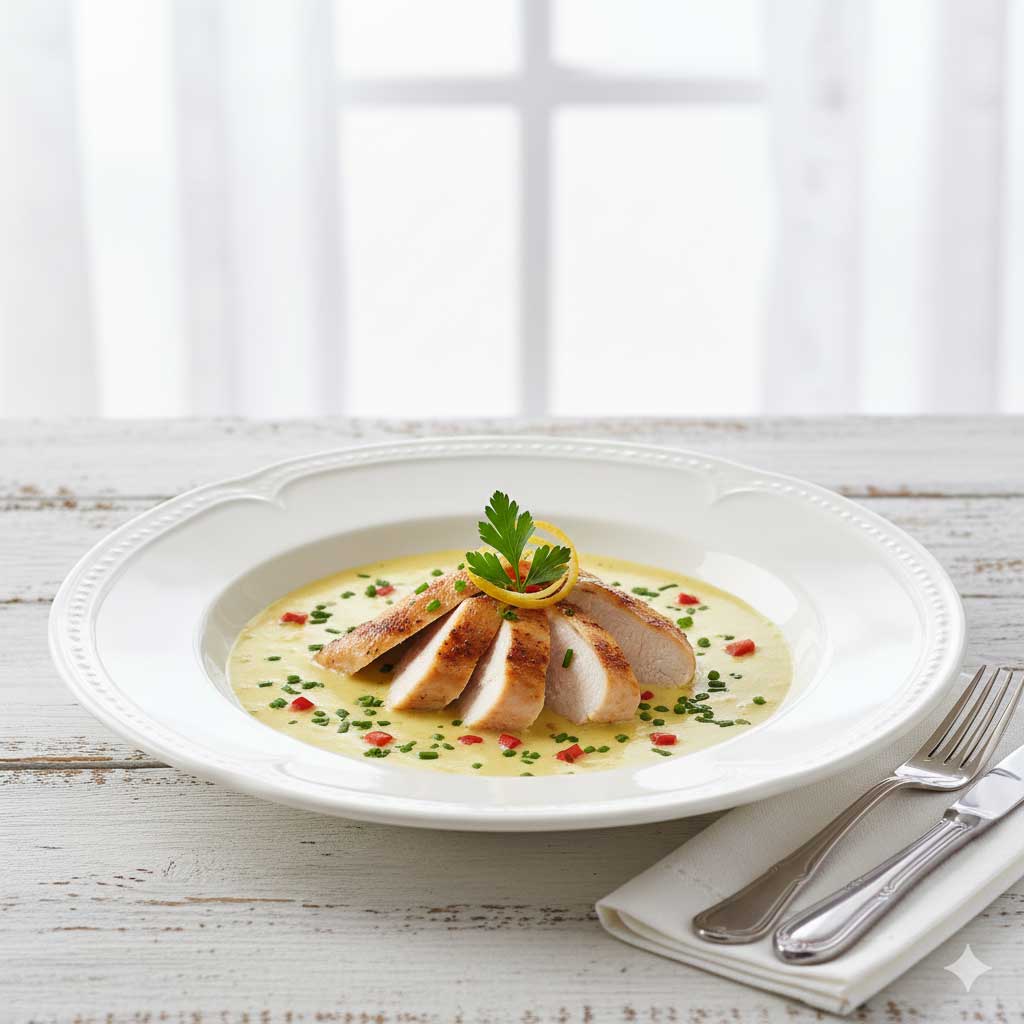
    The result is a dish of culinary elegance: a beautiful white plate presenting perfectly cooked scallops nestled in a pale, lemon-yellow sauce. It is the epitome of French cuisine’s belief that flavour should be inferred and suggested, not shouted.

    A Legacy of Adaptation

    The French curry may seem antiquated today, especially given the accessibility of authentic global cuisine. However, its historical significance is undeniable. It serves as a perfect example of cultural translation in food—how one culture’s complex, traditional dish is reinterpreted through the technological and philosophical lens of another.

    This dish also highlights the role of colonialism in shaping Western flavour profiles. It wasn’t the vibrant, heat-forward food of the masses that made it to the French elite’s dinner tables, but a carefully curated, softened version suitable for their established gastronomic sensibilities.

    Contemporary French chefs rarely feature the traditional French curry in its purest form, but its legacy lives on in modern fusion cuisine. We see its influence when chefs use curry powder to season a sophisticated hollandaise, or when a touch of Madagascan vanilla is added to a mild curry sauce to accompany duck—blending the aromatic warmth of the Orient with the classical richness of the Occident.

    In conclusion, the French curry is a quiet counterpoint to its fiery global cousins. It’s a sauce first, a spice profile second, and a testament to the enduring French dedication to technique, elegance, and the art of the perfect, creamy consistency. It reminds us that “curry” is a concept as much as it is a specific dish, capable of speaking many culinary languages, even with a delicate French accent.

  • The Great Worlds of Curry: The Madras Curry Blend

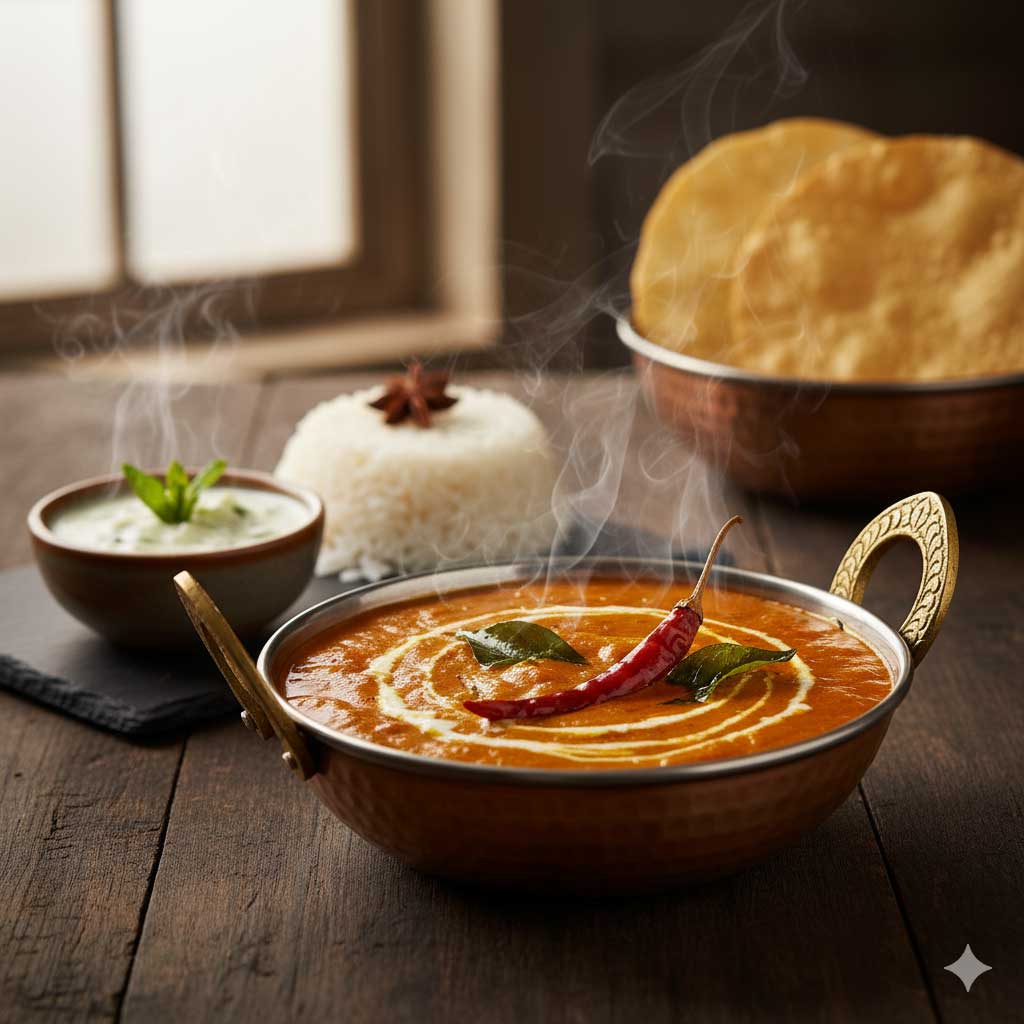
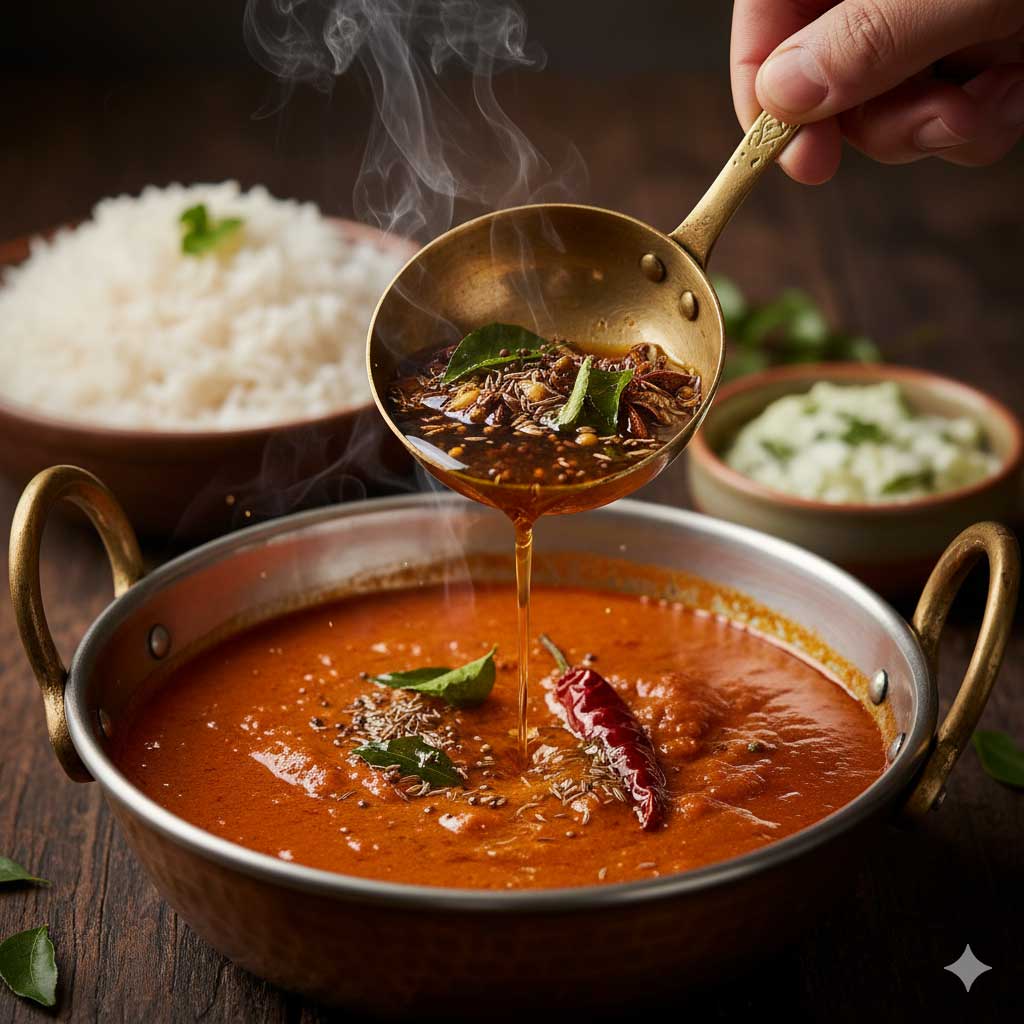
    Bowl of steaming Madras Curry, characterized by its intense, spicy red-orange color, garnished with dried red chili and curry leaves, served with basmati rice and cooling raita.

    The term Madras Curry is perhaps the most globally recognized name that represents a singular, standardized flavour profile within the vast category of Indian cuisine. However, the dish and the famous powder are an invention of the British Raj, a culinary export that has little to do with any single, authentic recipe found in Chennai (formerly Madras), the bustling port city in the state of Tamil Nadu. Instead, Madras Curry is an enduring legacy of the Anglo-Indian relationship, defining a bold, hot, and distinctly sour flavour profile popular in Western restaurants.

    The history of the Madras curry powder is closely linked to the early British occupation of India. As the East India Company set up trading posts, Westerners quickly fell in love with the complex, aromatic local dishes. Lacking the necessary time, knowledge, or specific ingredients to recreate authentic masalas in their home countries, they sought a simple, portable, and shelf-stable way to achieve a similar flavour. Thus, the commercially pre-mixed Madras Curry Powder was born, primarily manufactured for export to Britain.

    The Flavour Profile: Heat, Tang, and Turmeric

    The key characteristics that distinguish a Madras curry from a general Indian curry are:

    1. Intense Heat: A traditional Madras curry is defined by its significant use of dried red chilies. It is often positioned on restaurant menus as a “hot” or “fiery” option, making it far spicier than a creamy Korma or a mild Japanese Kare.
    2. Tanginess (Sourness): A crucial and defining element is the tanginess. This acidity is traditionally achieved through the liberal use of tamarind paste or, in many Western interpretations, lemon or lime juice. This sourness balances the rich spices and the heat, providing a complex, mouth-watering depth.
    3. Turmeric and Colour: Madras powder uses a high proportion of turmeric, giving the resulting dish a recognizable, deep orange-red hue.

    Unlike the complex, freshly ground masala that defines an authentic South Indian dish, the Madras powder relies on standardized quantities of dried spices, making it a reliable and easily replicated flavour across the globe.

    The Spice Blend Breakdown

    A typical, commercially produced Madras Curry Powder blend will heavily feature:

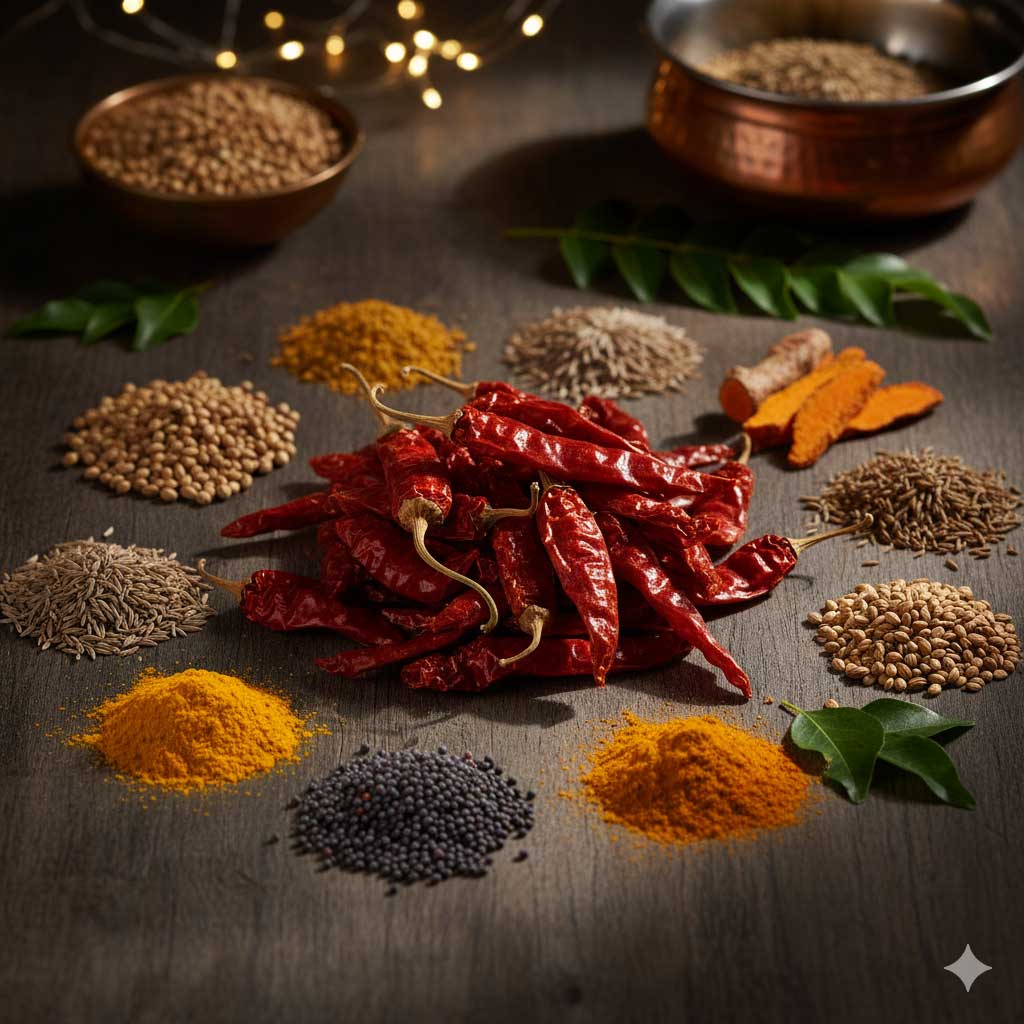
    • Red Chilies: Providing the signature heat and red color.
    • Coriander Seeds: The bulk of the blend, offering a citrusy and warm note.
    • Cumin Seeds: Earthy and savory.
    • Fenugreek Seeds: Adds a distinct bitterness and characteristic aroma.
    • Turmeric: Provides the orange/yellow color and earthy flavour.
    • Mustard Seeds: A common ingredient in South Indian cuisine, adding a sharp, nutty bite, often used whole in the tempering (tadka).

    In a prepared dish of Madras curry, the powder is typically bloomed in oil along with fresh aromatics like ginger, garlic, and sometimes curry leaves (another hallmark of Southern Indian cooking). The final gravy is often thinner than North Indian dishes, using water or coconut milk rather than heavy cream, although cream is sometimes added in Western kitchens to temper the heat.

    The actual Tamil cuisine from the region around Chennai often features intensely spiced, thinner broths known as kulambu or lentil-based dishes like sambar and rasam. These dishes are always built from scratch using fresh ingredients like roasted pulses, whole dried chiles, and coconut, traditionally ground into a wet paste on a grinding stone. The Madras curry powder simplifies this intricate daily process into a single, convenient item. Consequently, when preparing a ‘Madras curry’ dish, the best way to utilize the powder is still to follow the Indian technique: bloom it in hot oil or ghee with fresh garlic, ginger, and curry leaves to release its full aromatic potential before adding the liquid base, ensuring it never tastes simply like dried, dusty spices.

    South Indian Influence: The Myth vs. The Reality

    While the Madras curry is not a direct replication of a dish found in Chennai, it does draw inspiration from the culinary techniques of the Tamil region:

    • Curry Leaves: The use of fresh or dried curry leaves is indispensable in South Indian cooking, often fried first to infuse the oil with their pungent aroma. A good Madras curry will include these.
    • Lighter Gravy: Tamil curries are often made with a lighter gravy, allowing the rice to absorb the flavour easily. They are rarely as heavy or creamy as North Indian specialties like Korma.
    • Vegetable Focus: The Southern diet includes a greater variety of vegetables and legumes. While the global Madras curry is often served with meat (lamb or chicken), the principles echo a style more focused on lighter, tangier flavors.

    Modern Popularity and Legacy

    The Madras Curry remains a staple in curry houses from London to Sydney. Its straightforward, assertive flavor profile is deeply embedded in the Western perception of Indian food. For many, it is the classic, powerful, and deeply satisfying “hot curry.”

    Today, the popularity of authentic South Indian cuisine is growing internationally, showcasing dishes like the spicy Chettinad chicken or the tangy Goan fish curry, which are the true, complex culinary representatives of the region. However, the trusty Madras Curry powder continues its global journey, a reminder of how trade and cultural translation can simplify and popularize a complex flavour, leaving behind a culinary icon that is both a misnomer and a beloved, fiery tradition.

    It is a dish that embodies the colonial-era simplification of a deeply regional cuisine, but in doing so, it has defined a spicy, sour, and comforting corner of the global curry landscape.

    As with most Indian curries, the Madras variety is traditionally served with basmati rice, which provides a neutral foundation to soak up the intense, tangy gravy. Accompaniments often include a crisp, thin lentil wafer called pappadam, and cooling dairy sides like raita (yogurt mixed with cucumber and mint) to temper the dish’s signature heat. This balance of fiery flavour, cooling texture, and aromatic rice completes the experience, solidifying the Madras curry’s place not just as a blend, but as a complete, globally recognized meal.

  • The Magical Allure of Curry: A Global Wellness Tradition Rooted in Holistic Nutrition

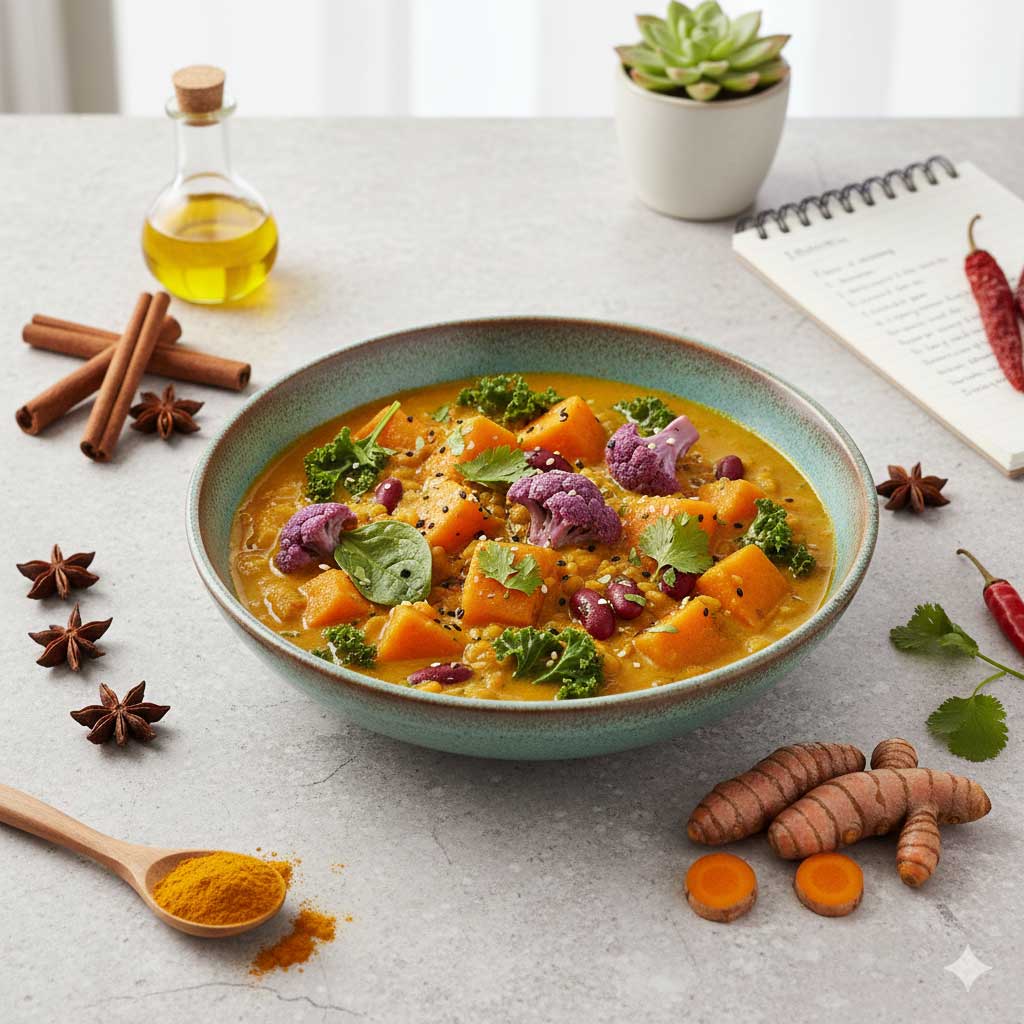
    Spiced curry soup featuring aromatic herbs and Holistic Curry Nutrition

    Few foods capture the meeting point between nourishment and sensory pleasure as beautifully as curry. More than a dish, curry represents a culinary philosophy built on the healing power of spices, aromatic vegetables, and whole-food ingredients—an approach perfectly reflected in Holistic Curry Nutrition. Across continents, cultures, and centuries, curry has evolved into an adaptable, comforting, and nutrient-rich staple—one that mirrors humanity’s ongoing relationship with food as medicine and the principles of Holistic Curry Nutrition.

    From the ancient masalas of India to the fragrant coconut-based pastes of Southeast Asia, and from Caribbean stews to Japanese comfort bowls, curry offers a window into diverse wellness traditions shaped by Holistic Curry Nutrition. Yet despite these variations, all curries share a common theme: they rely on the therapeutic properties of herbs and spices to create meals that support digestion, immunity, metabolic health, and emotional well-being—core pillars of Holistic Curry Nutrition.


    India: the birthplace of healing spice blends

    The roots of curry trace back thousands of years to the Indian subcontinent—specifically to the masala, a blend of herbs and spices used not only for flavor but also for holistic health. In Ayurveda, India’s traditional system of medicine, spices are essential tools for balancing digestion (agni), supporting detoxification, and harmonizing the doshas (individual mind-body constitutions).

    The power of the Indian masala

    A masala is far more than seasoning; it is a functional blend. Common Ayurvedic spices include:

    • Turmeric, rich in curcumin, supports joint health and reduces inflammation.
    • Cumin aids digestion and nutrient absorption.
    • Coriander cools the system and helps regulate blood sugar.
    • Ginger boosts circulation and strengthens digestion.
    • Fenugreek supports metabolic health and has antioxidant properties.
    Cooked curry dish showcasing rich spices and Holistic Curry Nutrition.

    Different regions created distinct curries with varying energetic and nutritional profiles:

    • Cooling, creamy korma, rich in nuts or yogurt, soothes the digestive tract.
    • Spicy, vinegar-bright vindaloo stimulates circulation and digestion.
    • Aromatic rogan josh, featuring Kashmiri chili and fennel, offers warmth without overwhelming heat.

    Indian cooking techniques also contribute to wellness. Tadka, the practice of tempering spices in oil or ghee, increases their bioavailability by releasing fat-soluble compounds and enhancing their therapeutic properties.

    In many Indian households, curry is not just comfort food; it is a daily wellness ritual.

    Southeast Asia: fresh aromatics and functional flavor balancing

    As curry traveled east, it adapted to new climates and new flora. In Thailand, Vietnam, and Indonesia, fresh aromatics replaced many of the dried spices common in Indian cooking. The result was a set of curry traditions built on vibrancy, balance, and metabolic harmony.

    Thai curry paste: a functional superfood base

    Thai curry pastes—red, green, yellow, and Massaman—are traditionally hand-pounded in a mortar and pestle, activating the oils in herbs and roots such as:

    • Lemongrass, a digestive aid
    • Galangal, known for antimicrobial and anti-inflammatory benefits
    • Kaffir lime, which supports detoxification
    • Fresh chilies, promoting circulation and endorphin release
    • Garlic and shallots, powerful immune-supporting ingredients

    Each curry type offers a unique nutritional profile:

    • Green curry: Fresh green chilies and herbs provide antioxidant density.
    • Red curry: Dried chilies add depth and a warming energetics ideal for metabolism.
    • Massaman curry: A fusion curry incorporating cinnamon, cardamom, and cloves—spices with strong anti-inflammatory and blood-sugar-balancing properties.

    Thai curry also emphasizes an intentional balance of the five tastes—sweet, sour, salty, bitter, and spicy—a key principle in many holistic nutrition systems for promoting satiety and digestive well-being.

    Global adaptations: comfort, nourishment, and cultural healing

    As people migrated—by choice or hardship—they carried their food traditions with them. Curry adapted to new lands not only in flavor but also in nutritional meaning.

    Purple cabbage curry soup highlighting Holistic Curry Nutrition benefits.

    The British influence: curry simplified (and transformed)

    During centuries of colonial exchange, curry powder emerged as a convenient adaptation of Indian masala. While less complex, this blend helped introduce Western cultures to spices such as turmeric and coriander—long before they became staples of modern wellness trends.

    Dishes like mulligatawny soup or chicken tikka masala brought warming spices into cold climates, providing comfort and immune-supporting benefits during winter months.

    Japanese Curry: a nourishing, gentle staple

    Japanese curry (kare), introduced via the British in the late 1800s, has since become a national comfort food. Its mild, thick, roux-based sauce is rich and satisfying, often paired with vegetables and lean proteins.

    While less spice-forward, kare offers warmth, grounding, and emotional comfort—an important aspect of holistic nutrition, which views food as nourishment for both body and mind.

    Caribbean and South African curries: spice meets soil

    Indian indentured laborers brought curry traditions to Trinidad, Jamaica, and South Africa, where the dish evolved using local crops and seasonings:

    • Caribbean curries often feature Scotch Bonnet peppers, allspice, and vibrant herbs—creating spicy, mineral-rich stews.
    • Durban curry in South Africa is intensely seasoned and famously served in “bunny chow,” a hollowed bread loaf—a unique fusion of cultures and nutrient-dense spices.

    These adaptations reveal curry’s remarkable ability to integrate into local food systems while retaining its wellness core.

    The science of spices: nutrition meets chemistry

    The health benefits of curry are backed by modern nutritional science. Spices are dense in phytonutrients, antioxidants, and bioactive compounds that support long-term health.

    • Curcumin (turmeric) is one of the most studied natural anti-inflammatory compounds.
    • Capsaicin (chilies) may boost metabolism and pain modulation.
    • Cinnamaldehyde (cinnamon) helps regulate blood sugar.
    • Eugenol (cloves) supports oral and digestive health.

    These ingredients work synergistically—meaning their benefits amplify when combined, a principle long recognized in Ayurvedic cooking.

    Curry as holistic nourishment

    Beyond its chemical and culinary complexity, curry embodies a wellness philosophy rooted in Holistic Curry Nutrition:

    • It uses whole, minimally processed ingredients.
    • It is adaptable for plant-based, gluten-free, anti-inflammatory, or high-protein diets.
    • It promotes mindful cooking, often involving slow preparation and aromatic engagement.
    • It fosters emotional comfort, cultural celebration, and communal eating.

    Curry is not something you master once—it is a lifelong exploration of flavor, culture, and nourishment grounded in the principles of Holistic Curry Nutrition. Whether simmering a golden dal in an Indian kitchen or blending a vibrant green curry paste at home, you join a global tradition that celebrates the healing power of spices, the joy of deeply nourishing food, and the timeless wisdom of Holistic Curry Nutrition.

  • The rich and spicy tapestry: a journey through the history of the curry spice

    history of curry

    The word “curry” conjures images of vibrant colors, intoxicating aromas, and complex flavors. It’s a dish that has captivated palates across the globe, evolving through centuries of trade, conquest, and culinary innovation. But what exactly is the curry spice, and where does its fascinating journey begin ? To understand the history of curry is to embark on a historical adventure that spans continents, cultures, and thousands of years.

    The Ancient Roots: A Pre-Colonial Genesis

    Long before the British Raj and the popularization of the term “curry” in the Western world, the concept of spiced stews and gravies was deeply embedded in the culinary traditions of the Indian subcontinent. Archaeological evidence suggests that the use of spices for flavoring food dates back thousands of years. Excavations at Mohenjo-Daro, a major city of the Indus Valley Civilization (2500-1900 BCE), have revealed mortar and pestles with traces of turmeric and ginger, indicating that these spices were ground and used in cooking.

    Ancient Indian texts also provide insights into early forms of spiced dishes. The Charaka Samhita, an ancient Sanskrit text on Ayurveda (around 400-200 BCE), mentions various preparations using a multitude of spices for both medicinal and culinary purposes. These early concoctions were not called “curry” but were essentially the foundational ancestors of what we recognize today. They involved simmering vegetables, lentils, or meats with a blend of freshly ground spices, often with a base of yogurt, coconut milk, or water. Each region, and even each household, would have its unique blend and method, creating an incredible diversity of flavors.

    curry plant

    The Etymological Enigma: How “Curry” Came to Be

    The term “curry” itself is not indigenous to India. It is widely believed to be a corruption of the Tamil word “kari” (கறி), which refers to any side dish eaten with rice, or more specifically, a sauce or gravy. Portuguese traders, who arrived in India in the late 15th century, were among the first Europeans to encounter these spiced dishes. They likely adopted and adapted the local term to describe the various spiced preparations they encountered.

    However, it was the British who truly popularized “curry” as a generic term for all Indian spiced dishes. During the era of the British East India Company in the 17th and 18th centuries, British officials and soldiers living in India developed a taste for these local foods. They brought recipes and their newfound culinary experiences back to Britain, simplifying the vast array of Indian dishes into the umbrella term “curry.” This simplification, while convenient for classification, often overlooked the intricate regional distinctions and specific names of dishes within India.

    The British Influence and the Birth of Curry Powder

    The British influence extended beyond mere nomenclature. As “curry” became fashionable in Britain, a demand arose for convenient ways to recreate these exotic flavors at home. This led to the invention of “curry powder” in the late 18th or early 19th century. Curry powder is a pre-mixed blend of ground spices, typically including coriander, cumin, turmeric, fenugreek, and chili powder, among others. While convenient, it is important to note that traditional Indian cooking rarely uses a single, generic curry powder. Instead, cooks typically grind fresh whole spices for each dish, or use specific spice blends (masalas) tailored to individual recipes.

    The proliferation of curry powder, however, played a significant role in popularizing curry globally. It made Indian flavors accessible to a wider audience and became a staple in many Western kitchens. This mass production also cemented the idea of “curry” as a singular dish rather than a diverse category.

    curry spice

    Global Diffusion: Curry’s Journey Beyond India

    The spread of curry is inextricably linked to colonialism, migration, and trade. As Indian indentured laborers were transported to various parts of the British Empire – including the Caribbean, Fiji, South Africa, Malaysia, and Singapore – they carried their culinary traditions with them. In these new lands, Indian flavors blended with local ingredients and techniques, giving birth to entirely new forms of curry.

    • Caribbean Curry: In the Caribbean, curry often features hotter peppers, different protein choices like goat or chicken, and a more pronounced use of coconut milk.
    • Southeast Asian Curry: Countries like Thailand, Malaysia, and Indonesia have their own distinct curry traditions. Thai curries, for instance, are renowned for their vibrant colors and use of fresh herbs like lemongrass, galangal, and kaffir lime leaves, often with a coconut milk base. Malaysian and Indonesian curries also feature a rich array of local spices and ingredients.
    • Japanese Curry: A surprisingly popular dish in Japan, Japanese curry is typically milder and sweeter than its Indian counterparts, often thickened with flour and served over rice with tonkatsu (fried pork cutlet) or other meats and vegetables. It gained popularity after being introduced by the British during the Meiji era.

    Curry spice in Modern Britain: A National Dish

    Perhaps nowhere outside the Indian subcontinent has curry been embraced as heartily as in Britain. From its colonial introduction, curry has evolved to become a quintessential part of British culinary identity. Indian restaurants, often run by Bangladeshi immigrants, proliferated across the UK in the latter half of the 20th century. Dishes like Chicken Tikka Masala and the Birmingham-born “Balti” became iconic. These creations highlight how the history of curry spice continues to evolve in modern culinary landscapes.

    Today, Britain boasts thousands of Indian restaurants, and curry is frequently cited as one of the nation’s favorite dishes, embodying a remarkable journey from exotic foreign food to beloved comfort staple.

    curry dish

    The Enduring Legacy: Curry spice as a Culinary Concept

    The term “curry,” despite its simplification of a vast and complex culinary landscape, has become a global signifier for a category of spiced dishes. It represents a culinary concept rather than a single recipe, encompassing an incredible diversity of ingredients, spice blends (masalas), cooking techniques, and regional variations.

    From the rich, creamy Kormas of North India to the fiery, tamarind-infused curries of the South, from the fragrant Green Curries of Thailand to the comforting beef curries of Japan, the thread of curry spice connects them all through the shared principle of simmering ingredients in a flavorful, spiced sauce. This incredible diversity showcases the living, ever-adapting history of curry.

    The history of curry spice is a story of exploration, cultural exchange, and culinary creativity. It reminds us that food is rarely static; it travels, transforms, and thrives, continually enriching our global gastronomic landscape.

    Curry girl

    Curry

    Curry post

  • Curry: A Global Journey of Flavor, Culture, and Comfort

    Few foods are as universally loved—and as widely interpreted—as curry. Found in homes and restaurants from India to Japan, Thailand to Jamaica, and Britain to South Africa, curry is not a single dish but a world of flavors, histories, and traditions. Its story spans continents, colonial encounters, spice routes, migrations, and creative reinvention. For anyone curious about the history of curry, this global journey reveals how deeply interconnected food and culture can be. And whether simmered slowly on a family stove or ordered from a bustling street market, curry remains one of the world’s most comforting and expressive culinary creations.

    A Brief History of Curry

    The history of curry begins with the ancient Tamil word kari, meaning “spiced sauce,” but the culinary concept we now associate with curry is thousands of years old..

    In the Indus Valley civilization—one of the world’s earliest urban cultures—archaeologists have uncovered evidence of turmeric, ginger, and garlic in ancient cooking pots, suggesting that proto-curry mixtures may date back more than 4,000 years. Indian cuisine continued to evolve under diverse regional kingdoms, each developing its own masalas (spice blends) tailored to climate, agriculture, and culture.

    The global rise of curry began with the spice trade. Arab merchants carried Indian spices westward, and by the Middle Ages, pepper, cinnamon, and cardamom were prized luxuries in Europe. Later, during the period of British colonial rule, curry became a bridge between cultures. British officers who developed a taste for Indian cuisine tried to recreate it back home, leading to the first English “curry powder,” an approximation of Indian masalas designed for Victorian kitchens.

    History of curry

    As global migration increased, the concept of curry traveled with people:

    • Indian laborers brought curry traditions to the Caribbean, giving birth to Jamaican curry goat and Trinidadian doubles.
    • Japanese naval officers encountered British-style curry and transformed it into the mild, comforting kare raisu beloved across Japan today.
    • Thai cooks incorporated local herbs like lemongrass, galangal, and kaffir lime into vibrant coconut-based curries.

    Today, curry is less a recipe than a culinary conversation—one that adapts, evolves, and absorbs local identity wherever it travels.

    curry in kitchen

    Anecdotes & Cultural Flavor

    Few foods inspire as many personal stories as curry. In many cultures, curry isn’t just a dish; it’s an expression of identity and memory.

    The Family Masala

    In many Indian households, spice blends are guarded like family heirlooms. A grandmother’s masala recipe might be written down (rarely) or passed on by smell and intuition. Some families roast their spices before grinding; others sun-dry them on terraces, infusing them with the warmth of the afternoon. The taste of curry, in these homes, is the taste of lineage.

    An old joke in North India goes: “If you want to marry into a family, learn their garam masala first.” Whether true or not, it reflects how deeply curry is tied to domestic tradition.

    Curry and Colonial Curiosity

    A British anecdote tells of an 18th-century dinner guest who asked for “that excellent spicy Indian ragout” again. Unable to recall the dish’s Tamil name, the host simply called it “curry.” The term stuck, much to the amusement—and occasional annoyance—of Indians who know that every regional dish has its own name, from vindaloo to korma, saag, chettinad, or kari kuzhambu.

    The Comfort of Kare

    In Japan, curry is as beloved as ramen or sushi. Ask a Japanese college student what they ate during exam season, and many will recall giant pots of homemade curry simmering for days, growing richer with every serving. It is affectionately called “the national comfort food.”

    Three Delicious Curry Recipes to Try at Home

    Here are three diverse recipes that showcase curry’s global personality.

    1. Classic Indian Chicken Curry (North Indian Style)

    Ingredients:

    • 1.5 lbs chicken pieces
    • 2 onions, finely chopped
    • 3 tomatoes, blended or chopped
    • 4 cloves garlic, minced
    • 1-inch ginger, minced
    • 2–3 tbsp oil
    • 1 bay leaf
    • 1 tsp cumin seeds
    • 1 tsp turmeric
    • 2 tsp coriander powder
    • 1 tsp garam masala
    • 1 tsp red chili powder
    • Salt to taste
    • Fresh cilantro for garnish

    Instructions:

    1. Heat oil and add cumin seeds and bay leaf until fragrant.
    2. Add onions and cook until golden brown.
    3. Stir in garlic and ginger; sauté for one minute.
    4. Add tomatoes and spices; cook until oil separates from the masala.
    5. Add chicken pieces and coat well with the mixture.
    6. Add 1 cup water and simmer for 25–30 minutes.
    7. Garnish with cilantro and serve with rice or flatbread.

    This curry is deeply aromatic, richly spiced, and endlessly adaptable—just like the regions that inspired it.


    2. Thai Green Curry

    Ingredients:

    • 2 tbsp green curry paste
    • 1 can (13.5 oz) coconut milk
    • 1 lb chicken or tofu
    • 1 cup Thai eggplant or zucchini
    • 1 red bell pepper
    • 1 tbsp fish sauce (or soy for vegan)
    • 1 tbsp brown sugar
    • Handful of Thai basil
    • Kaffir lime leaves (optional)

    Instructions:

    1. Heat a spoonful of coconut milk until it bubbles and releases aroma.
    2. Stir in the green curry paste and cook for 1–2 minutes.
    3. Add the remaining coconut milk, chicken/tofu, and vegetables.
    4. Add fish sauce, sugar, and lime leaves.
    5. Simmer on low for 15 minutes, until fragrant and silky.
    6. Finish with Thai basil.

    Thai curry is all about balance: creamy, spicy, fragrant, and fresh.


    3. Japanese Curry Rice (Kare Raisu)

    Ingredients:

    • 1 lb beef, chicken, or vegetables
    • 2 onions
    • 2 carrots
    • 2 potatoes
    • 1 apple, grated
    • 3 cups water
    • 1 block Japanese curry roux
    • Cooked rice

    Instructions:

    1. Sauté onions until caramelized.
    2. Add meat and vegetables; lightly brown.
    3. Pour in water and simmer until everything softens.
    4. Add grated apple for sweetness.
    5. Stir in curry roux until thick and glossy.
    6. Serve over steaming rice.

    This curry is mild, comforting, and subtly sweet—perfect for cozy evenings.

    Check also this great recipe of delicious Autumn Chickpea Curry!

    Curry recipes

    Curry’s Ever-Expanding Story

    The history of curry shows that it is far more than a recipe—it is a symbol of cultural exchange, adaptation, and memory. It’s eaten during celebrations, shared among friends, reinvented by chefs, and passed down through generations. Its ability to absorb local ingredients, preferences, and stories makes it one of the world’s most adaptable foods.
    Whether fiery and complex, creamy and mild, or bright with fresh herbs, curry continues to evolve. Every pot tells a story—and adds a new chapter to the history of curry.


  • 🍲 The global phenomenon of curry: history, flavor, and the key of Indian recipes

    curry powder

    Curry: a flavorful journey through history, culture, and cooking

    Curry is one of the world’s most celebrated dishes, known for its rich flavors, vibrant colors, and irresistible aromas. Although the word “curry” is often used casually to describe a wide range of dishes, its history and meaning are far more complex. Today, curry has become a global culinary icon, shaped by centuries of cultural exchange, spice trading, migration, and adaptation. In this article, we explore what curry truly is, its origins, its cultural impact, and how it continues to evolve in modern kitchens. This guide also includes essential culinary keywords for curry recipes, spices, indian cuisine, and asian food, helping improve seo visibility for readers searching for authentic information.

    What exactly is curry?

    At its core, curry is not a single dish but a broad category of preparations made with a blend of spices, herbs, and often a base of onions, garlic, and ginger. The spices usually include turmeric, coriander, cumin, chili powder, and cardamom, but dozens of other variations exist. In fact, curry differs dramatically depending on the region. Indian curries are often characterized by complex spice blends, while Thai curries rely heavily on aromatic pastes made from chilies, lemongrass, and galangal. Japanese curry tends to be milder and thicker, often served with rice and breaded cutlets.

    The term “curry” itself was popularized during the colonial era. It is believed to have been derived from “kari,” a tamil word meaning sauce, but the dishes existed long before the term took root in english vocabulary. Because of this, curry has become a flexible, catch-all culinary term rather than a precise definition.

    The deep history of curry

    Curry has ancient origins, with archaeological evidence showing that spice blends resembling curry existed in the indus valley civilization more than 4000 years ago. These early mixtures used turmeric and ginger, ingredients still central to many curry dishes today. Over time, trade routes such as the spice route spread these ingredients to the middle east, africa, and europe. Merchants carried not only ingredients but also knowledge about how to mix spices and prepare aromatic dishes.

    The arrival of european traders, especially the portuguese and the british, played a major role in shaping modern curry. Chili peppers, which are now essential in many curry recipes, came from the americas and were introduced to india by the portuguese. Colonial cooks adapted local recipes to suit european tastes, giving birth to new versions such as “curry powder,” a standardized spice blend intended to mimic indian flavors.

    Through migration and global movement, curry adapted to each region’s ingredients and preferences. This explains why we now have british curry houses, japanese curry rice, caribbean curry goat, and thai green curry, each with its distinct identity.

    The cultural importance of curry

    Curry is more than just food; it is a symbol of identity, tradition, and comfort. In india and south asia, curry is deeply connected to daily life and family traditions. Each household often has its own signature mixture of spices, called “masala,” passed down through generations. Preparing curry can be a deeply personal ritual, involving roasting spices, grinding them, and building layers of flavor.
    In thailand, curry pastes reflect the balance between heat, sweetness, acidity, and herbal freshness. Thai curries like red, green, and yellow curry are inseparable from the country’s culinary identity. Similarly, japanese curry has become a comfort food, served in school cafeterias and home kitchens.

    In the caribbean, curry was brought by indentured laborers from india and blended with african and creole influences. Dishes like trinidadian curry chicken or jamaican curry goat are now staples of island cuisine.

    Curry’s global journey shows how food evolves with culture. Each variation tells a story of migration, trade, and adaptation.

    Key ingredients that define curry

    The heart of curry lies in its spices. Some of the most essential ingredients include:

    • turmeric: responsible for curry’s golden color and earthy flavor
    • cumin: adds warmth and depth
    • coriander: provides a citrusy, aromatic quality
    • ginger and garlic: create a savory, spicy foundation
    • chili peppers: introduce heat and complexity
    • cardamom, cinnamon, and cloves: bring sweetness and fragrance
    curry ingredients

    In thai curries, ingredients like lemongrass, kaffir lime leaves, shrimp paste, and fresh chilies define the flavor profile. Japanese curry relies more on roux, which thickens the sauce and gives it a hearty, stew-like texture.

    These ingredients not only provide flavor but also offer health benefits. Many spices in curry are known for their anti-inflammatory, antioxidant, and digestive properties. Turmeric, for example, contains curcumin, which is widely studied for its health potential.

    How curry is made: techniques and traditions

    While recipes vary between cultures, the basic techniques of making curry share common principles. The first step often involves heating oil and sautéing aromatics such as onions, garlic, and ginger. Spices are then added, sometimes toasted beforehand to deepen their flavor. Next comes the main ingredient: vegetables, meat, fish, or tofu. Finally, liquids such as coconut milk, yogurt, broth, or water help create the sauce.

    Thai curry relies on frying curry paste in coconut oil before adding coconut milk. Indian curry frequently uses tomatoes, yogurt, or cream for richness. Japanese curry is thickened with a roux made from butter and flour, giving it a smooth texture.

    Each method creates unique flavors, yet the essence of curry—layered spices and aromatic depth—remains constant.

    Learn how to make curry here.

    The global popularity of curry today

    Today, curry is a global phenomenon. Food lovers around the world search for easy curry recipes, spicy curry dishes, authentic indian curry, and healthy curry meal ideas. Restaurants specialize in regional curries, supermarkets offer curry pastes and spice blends, and home cooks experiment with fusion versions. Curry remains popular because it is adaptable: it can be mild or spicy, vegan or meat-based, rich or light.

    As more people seek bold flavors and diverse cuisines, curry continues to stand out as a versatile and beloved dish.

    indian recipe

    Conclusion

    Curry is not just a recipe; it is a culinary journey that spans continents, cultures, and centuries. From its ancient origins to its global presence today, curry reflects human history, creativity, and connection. Whether enjoyed in a traditional indian kitchen, a bustling thai street market, or a cozy home dinner, curry remains a dish that brings people together through spice, aroma, and flavor.

    Learn about cumin here!

  • The Great Worlds of Curry: Japanese Curry

    If you ask a Japanese person to name one of their favourite comfort foods, the answer will frequently be Kare (Japanese Curry). Far from being an authentic dish imported directly from India, Japanese curry is a prime example of culinary globalization and adaptation, having arrived via the British Empire and evolved into a dish so distinctly Japanese that it rivals ramen and sushi in its popular appeal. Its texture, flavour profile, and method of preparation set it apart entirely, making it one of the gentlest and most universally beloved curries in the world.

    A British Introduction

    The history of Japanese curry is surprising. Curry was introduced to Japan during the Meiji Era (1868–1912) by the British, who had, in turn, adapted Indian cuisine for their own military and naval needs. The Royal Navy, seeking nutritious and easy-to-prepare meals for long sea voyages, developed a recipe that combined curry powder with a thick, gravy-like sauce, often served over rice. When the Japanese Navy adopted the recipe from the British to combat beriberi (a disease linked to Vitamin B1 deficiency), the dish quickly entered the national consciousness.

    Crucially, the British version used flour to thicken the sauce, which aligned perfectly with traditional Japanese stew-making techniques, solidifying its place in the Japanese diet. It was easily replicable and highly adaptable to local ingredients, moving from a naval staple to a school lunch favourite and, eventually, a true national dish.

    The Texture and Taste of Comfort

    The most defining feature of Japanese curry is its viscosity and sweetness. Unlike the bright, complex, and sometimes sharp flavours of South Asian curries, Japanese curry is thick, dark brown, slightly sweet, and features a notably mellow, umami-rich flavour.

    Key differences in flavour profile:

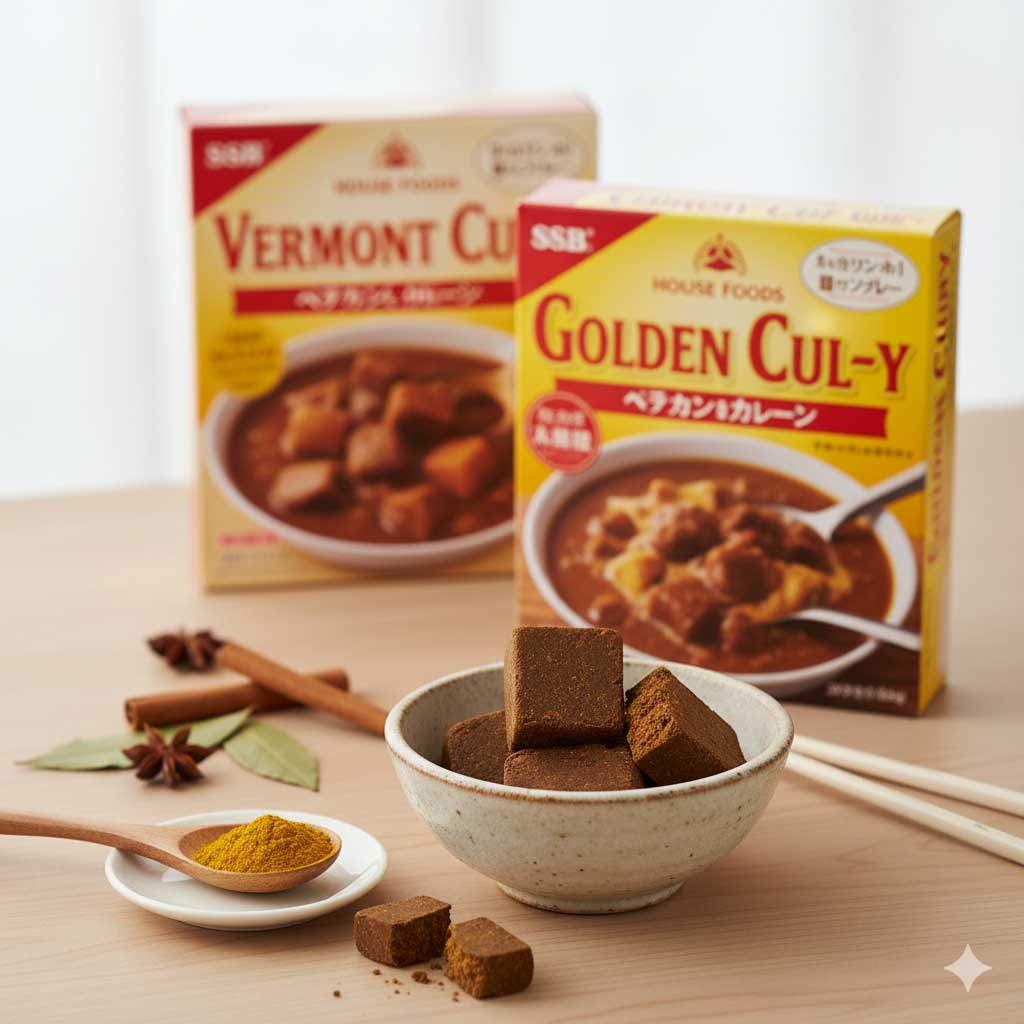
    1. Thickness: The sauce is significantly thicker than other curries, achieved through the use of a pre-made roux block called a “curry brick” or kare rū. These bricks contain flour, oil, spices, and often flavour enhancers like MSG or soy sauce, giving it a uniform, heavy consistency similar to a Western gravy.
    2. Sweetness and Umami: Instead of relying on heat, Japanese curry leans heavily into savouriness and subtle sweetness. Ingredients like grated apples, honey, or banana are often added, and the umami depth comes from ingredients like caramelized onions, soy sauce, and sometimes even miso paste.
    3. Spices: The spice blend is much milder and typically less dominant than in Indian or Thai curries. While it contains turmeric, coriander, and cumin, the overall flavour is a subdued, integrated warmth rather than a fiery punch.

    Anatomy of a Kare Dish

    Japanese Curry is almost always served in one of three ways, all based on a foundation of plain steamed white rice:

    • Curry Rice (Kare Raisu): The most popular format. A generous portion of thick curry sauce poured over rice, usually containing chunks of beef, pork, chicken, carrots, and potatoes, which maintain their shape and integrity even after long simmering.
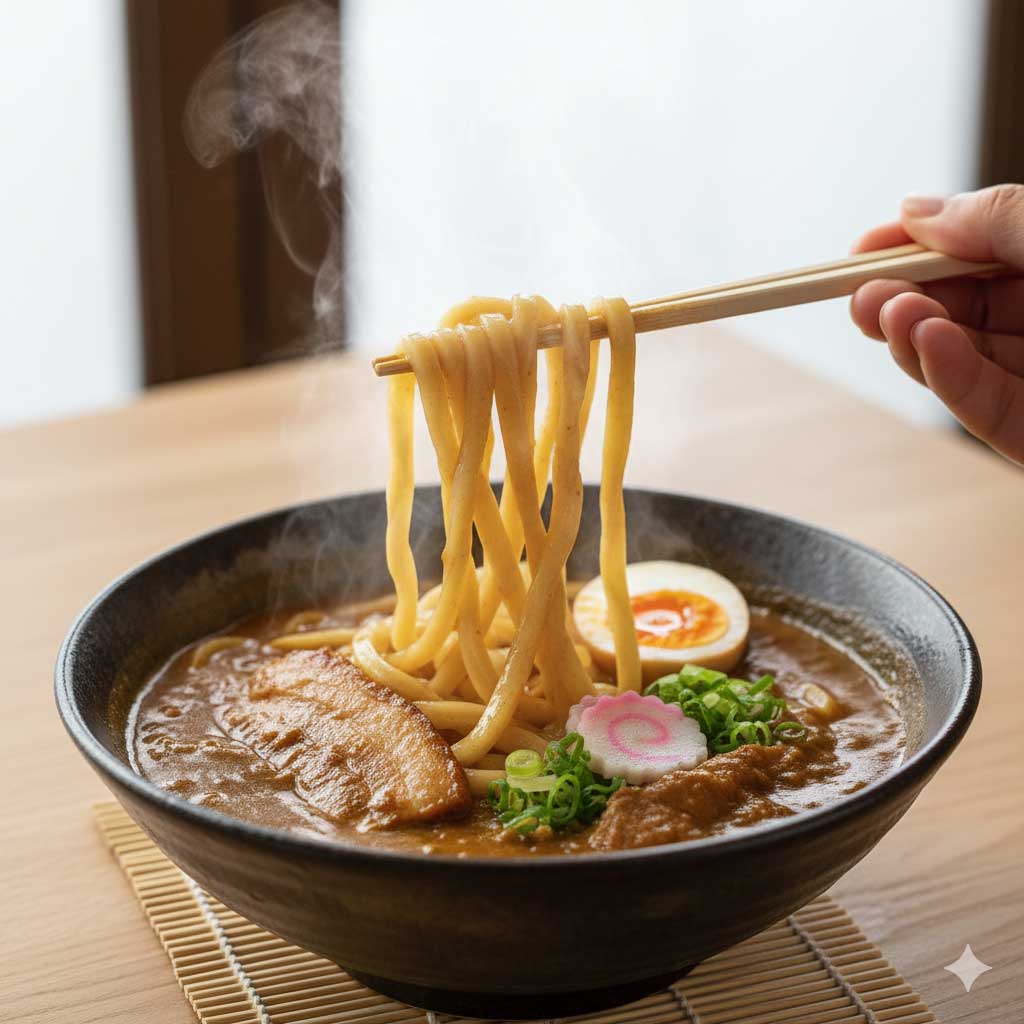
    • Curry Udon (Kare Udon): Thick, chewy wheat noodles served in a broth, over which the thick curry sauce is poured. This creates a very hearty, warming, and comforting dish.
    • Curry Bread (Kare Pan): A popular snack where the curry sauce is wrapped in a piece of dough, coated in breadcrumbs, and deep-fried until golden brown.

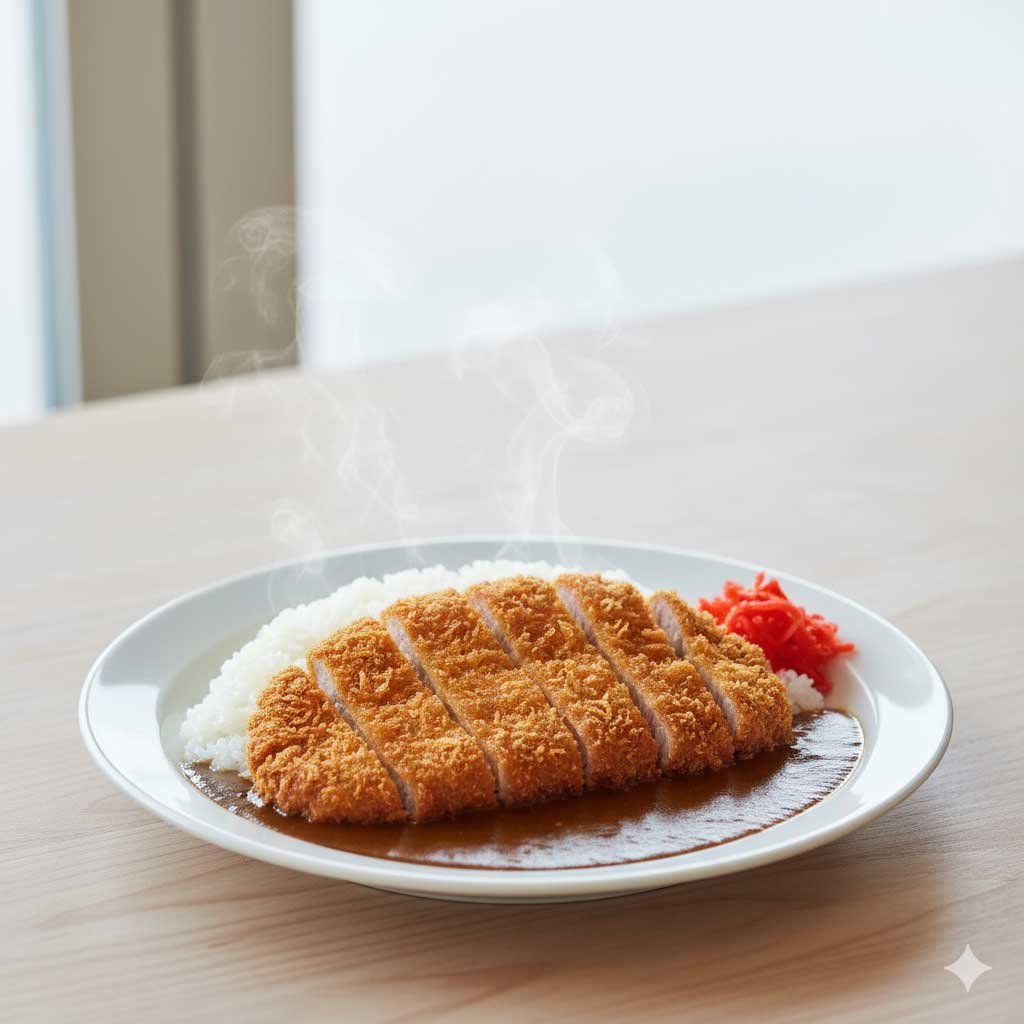
    For those seeking a bit of textural contrast, katsu (a deep-fried pork or chicken cutlet) is frequently added, transforming the dish into Katsu Kare. The crispy coating of the katsu provides a delightful counterpoint to the soft rice and thick sauce.

    Preparation: The Art of the Roux Brick

    The convenience of the kare rū is central to Japanese home cooking. It made the preparation of curry simple and foolproof, transforming a complex, multi-spice dish into a quick, one-pot family meal.

    A typical preparation involves:

    1. Sautéing the main ingredients (meat, onions, carrots, potatoes).
    2. Adding water or broth and simmering until the vegetables are tender.
    3. Stirring in the blocks of kare rū until they are fully dissolved, instantly thickening the sauce and adding the seasoned flavour.

    This reliance on a standardized, pre-mixed base ensures consistency, which is highly valued in Japanese commercial food preparation, from restaurants to vending machines.

    Kare in Modern Japan

    Japanese curry’s popularity is so pervasive that it is considered a national institution. It is celebrated as the ultimate yōshoku (Western-influenced Japanese food) dish. Restaurants specializing in curry, such as the massive chain Coco Ichibanya, allow customers to customize everything from the level of spice (typically a scale from 1 to 10) to the amount of rice and the huge array of toppings.

    Unlike the fiery complexity of Indian curry or the herbaceous brightness of Thai curry, the Japanese curry offers warmth, simplicity, and a familiar, reassuring flavour. It is the perfect embodiment of Japan’s ability to take a foreign concept, meticulously refine it, and make it entirely its own—a mild, sweet, and satisfyingly thick brown gravy that has become the definition of comfort food across the archipelago.