Author: Loïk Boyer

  • Spice Superstars: Dishes That Wouldn’t Be the Same

    We’ve explored the rich histories and subtle nuances of salt, pepper, and cinnamon. We’ve seen how they shaped civilizations, fueled exploration, and carved out their unique identities in the culinary world. But where do these humble heroes truly shine? Where do they stop being mere ingredients and become the very soul of a dish?

    In this article, we’ll embark on a flavorful journey, celebrating the iconic dishes that simply wouldn’t exist, or at least wouldn’t taste the same, without the indispensable contributions of our beloved spices. From comforting classics to exotic delights, these culinary masterpieces are a testament to the transformative power of a pinch, a grind, or a fragrant stick.

    Salt: The Universal Dish Harmonizer

    While salt’s role is often one of subtle enhancement rather than overt flavor, its absence is immediately and painfully felt. Salt doesn’t just make food “salty”; it balances, brightens, and brings out the latent flavors in everything it touches.

    Salted Caramel: This might seem obvious, but think about it: the magic of salted caramel lies precisely in the salt. Without it, you have mere sweetness, cloying and one-dimensional. A touch of sea salt cuts through the richness, preventing it from being overly saccharine and introducing a tantalizing dance of sweet and savory on the palate. It’s the perfect example of salt elevating and transforming a flavor profile rather than simply adding its own. The crunchy flakes of a finishing salt on a gooey caramel treat are pure textural and taste bud bliss.

    French Fries (and nearly all savory snacks): Imagine a plate of perfectly crispy, golden-brown French fries. Now imagine eating them without a single grain of salt. Bland, right? Salt is crucial for enhancing the potato’s natural flavor, providing that essential savory counterpoint, and, especially with coarse salt, adding a satisfying textural crunch. This principle extends to virtually every savory snack, from popcorn to potato chips, proving that salt is the undisputed king of snack-time satisfaction.

    Cured Meats (e.g., Prosciutto, Bacon): Here, salt isn’t just a flavor enhancer; it’s the very core of the product. Curing meats with salt is one of the oldest preservation techniques known to humankind. The salt draws out moisture, inhibiting bacterial growth, and transforms the texture and flavor of the meat, creating complex, umami-rich delicacies like prosciutto, salami, and bacon. These foods are a direct embodiment of salt’s ancient power and culinary artistry.
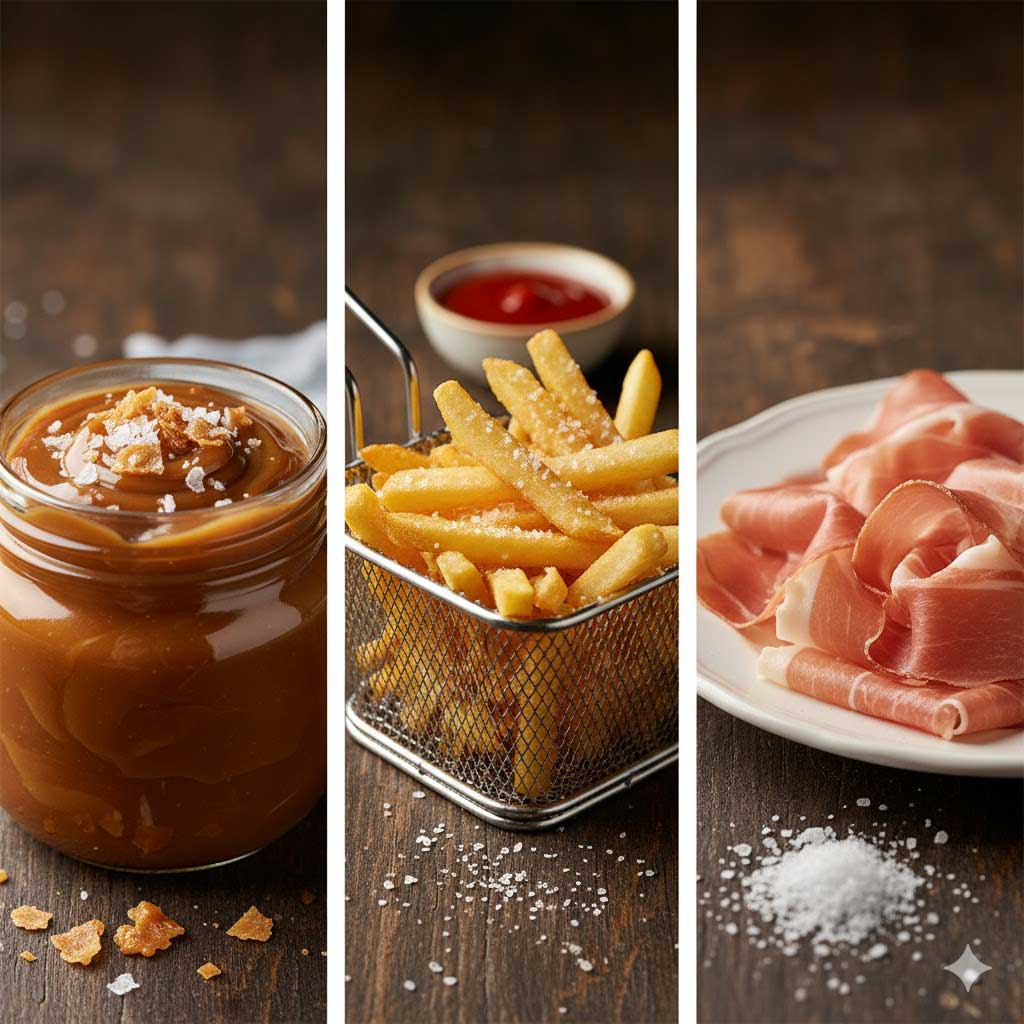
    A three-panel vertical collage on a dark wooden background highlights the use of salt in various dishes. The left panel shows a jar of smooth salted caramel topped with flaky sea salt and brittle. The middle panel features crispy golden French fries in a metal basket, heavily seasoned with salt, with a small bowl of ketchup in the background. The right panel displays thinly sliced cured ham (prosciutto) on a white plate, with a pile of coarse salt next to it.

    Black Pepper: The Pungent Dish Perfectionist

    Black pepper brings a different kind of magic to the table: a warm, pungent heat that awakens the senses and adds a vital spark. It’s the perfect partner to richness and a brilliant counterpoint to sweetness.

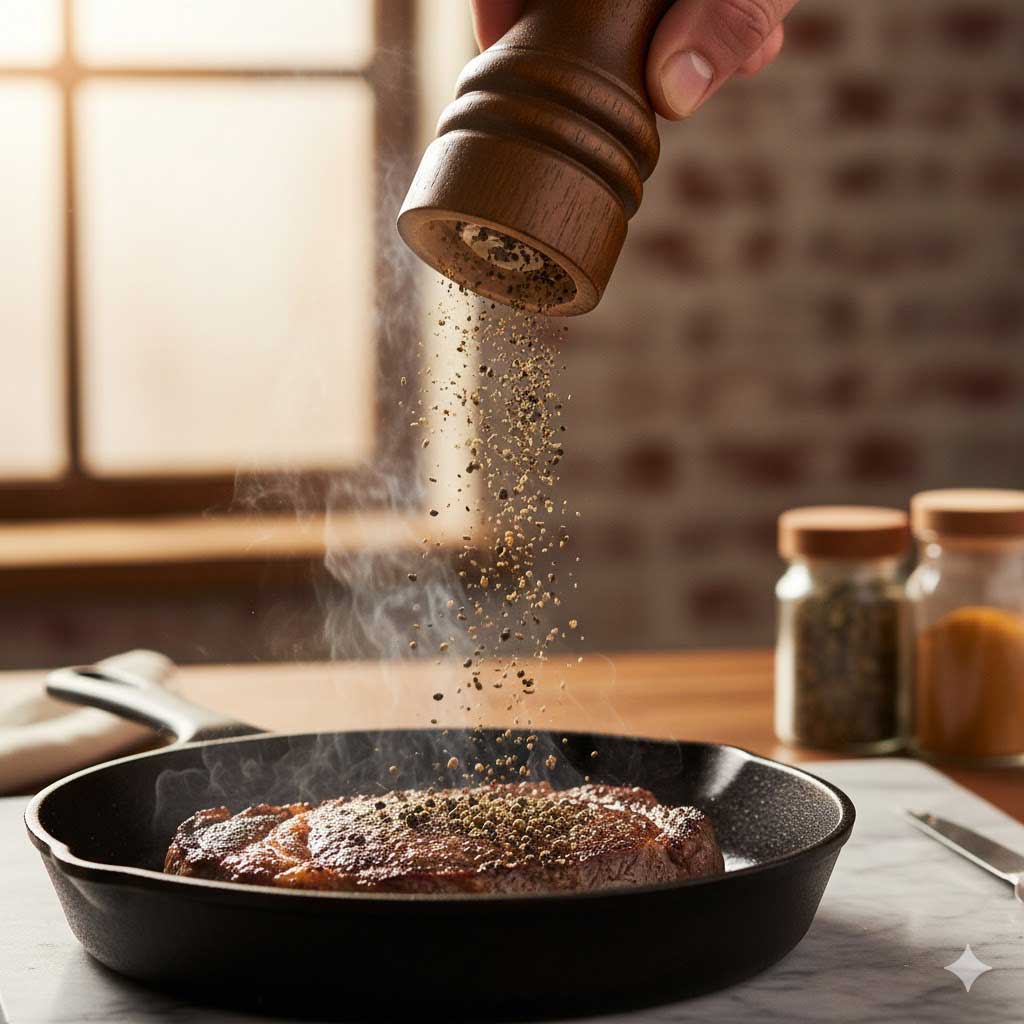
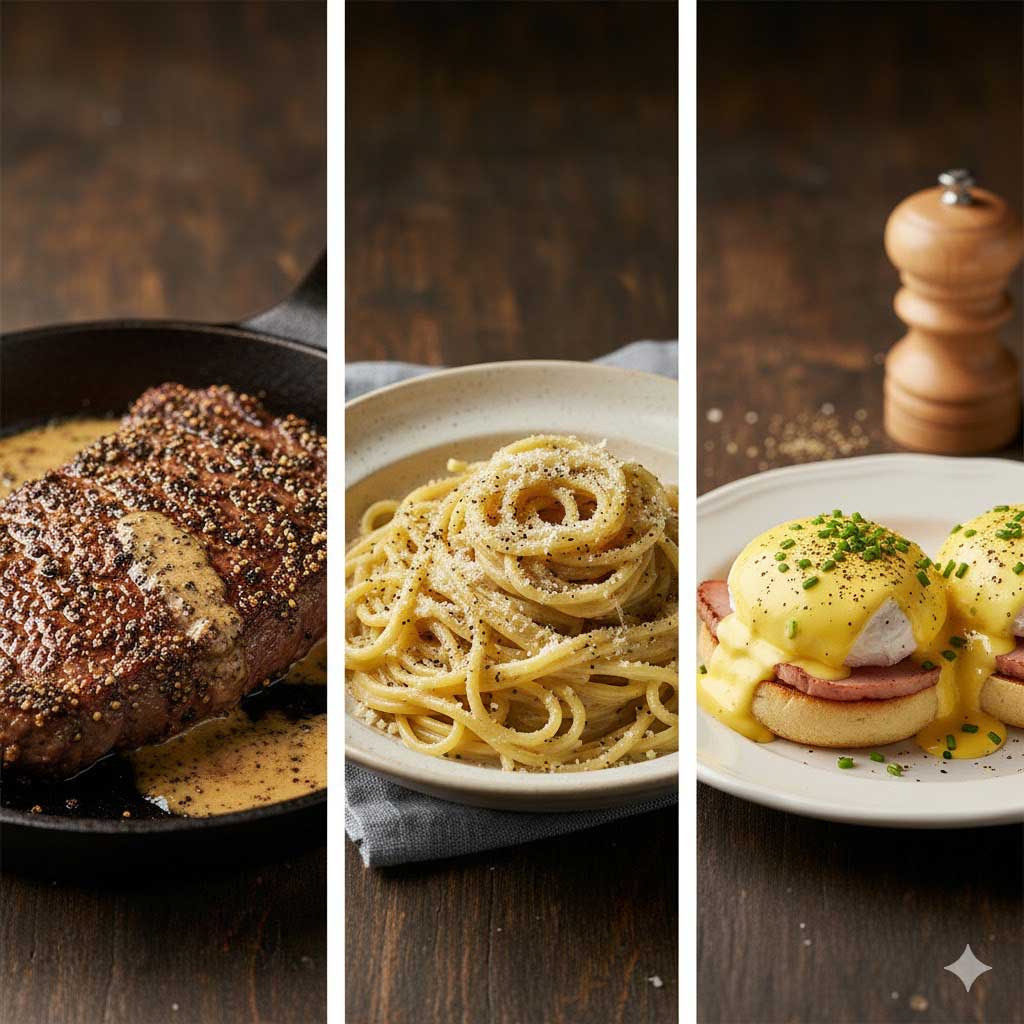
    Steak au Poivre: This classic French dish literally translates to “steak with pepper.” It features a juicy steak, often a tenderloin or sirloin, coated generously in coarsely crushed black peppercorns before being seared. The pepper forms a crust that, when cooked, delivers an intense burst of aromatic heat and a delightful textural crunch with every bite. It’s usually finished with a creamy, cognac-flambéed sauce that beautifully balances the pepper’s assertive kick, making it a quintessential showcase for black pepper’s prowess.

    Cacio e Pepe: Hailing from Rome, this deceptively simple pasta dish is a masterclass in minimalism and flavor. “Cacio e pepe” means “cheese and pepper,” and those are its two main flavor components, alongside pasta water. The magic happens when freshly ground black pepper is toasted in a pan to release its volatile oils, then emulsified with Pecorino Romano cheese and starchy pasta water to create a luscious, creamy sauce. The pepper isn’t just an afterthought; it’s the aromatic, spicy heart of the dish.

    Eggs Benedict (or any egg dish): While not as dramatic as the first two, consider your morning eggs. A generous grind of fresh black pepper over scrambled, fried, or poached eggs, or even a decadent Eggs Benedict, is almost non-negotiable for many. The pepper cuts through the richness of the yolk and hollandaise, adding a crucial layer of flavor and a gentle warmth that elevates a simple breakfast into a satisfying meal.
    Cinnamon: The Aromatic Dish All-Rounder

    Cinnamon’s versatility is truly astounding, effortlessly leaping from sweet to savory and bridging culinary traditions across continents. Its warm, sweet, and spicy notes are irreplaceable in many beloved dishes.

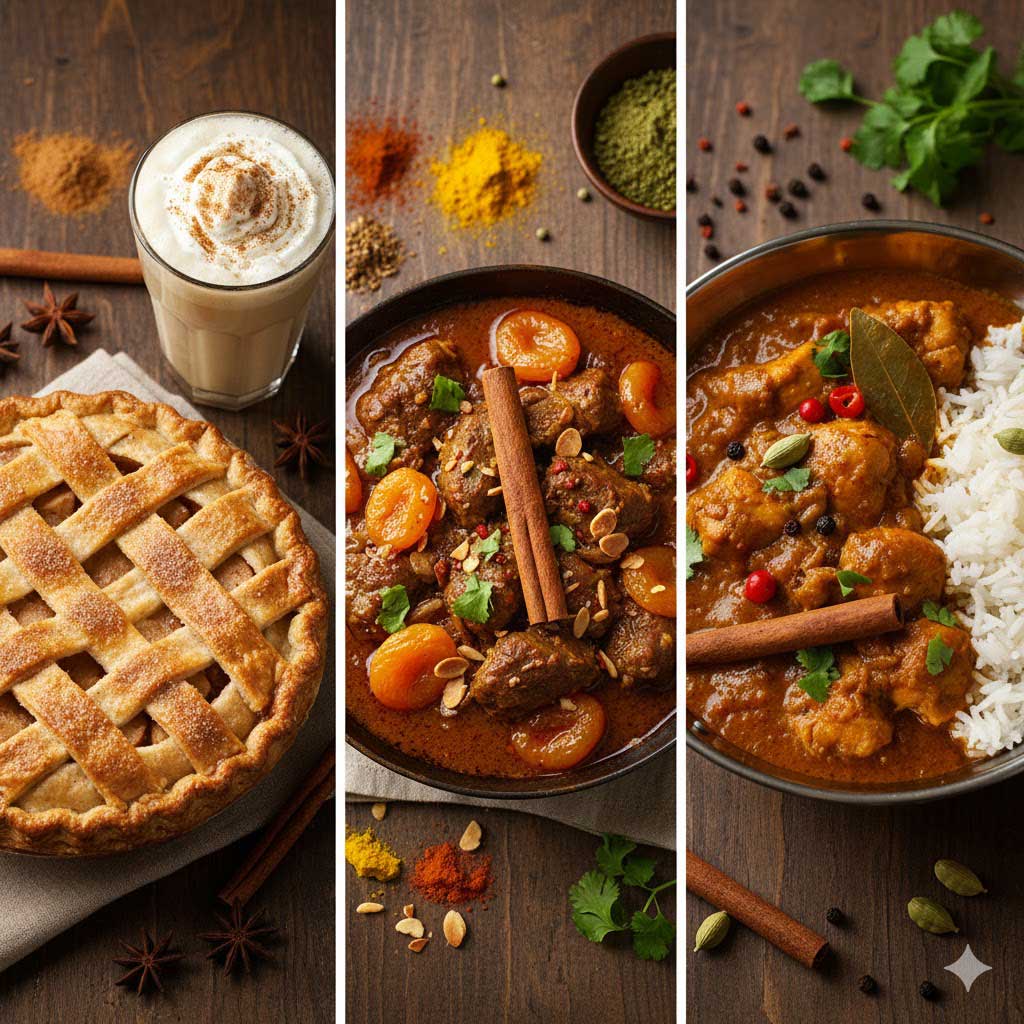
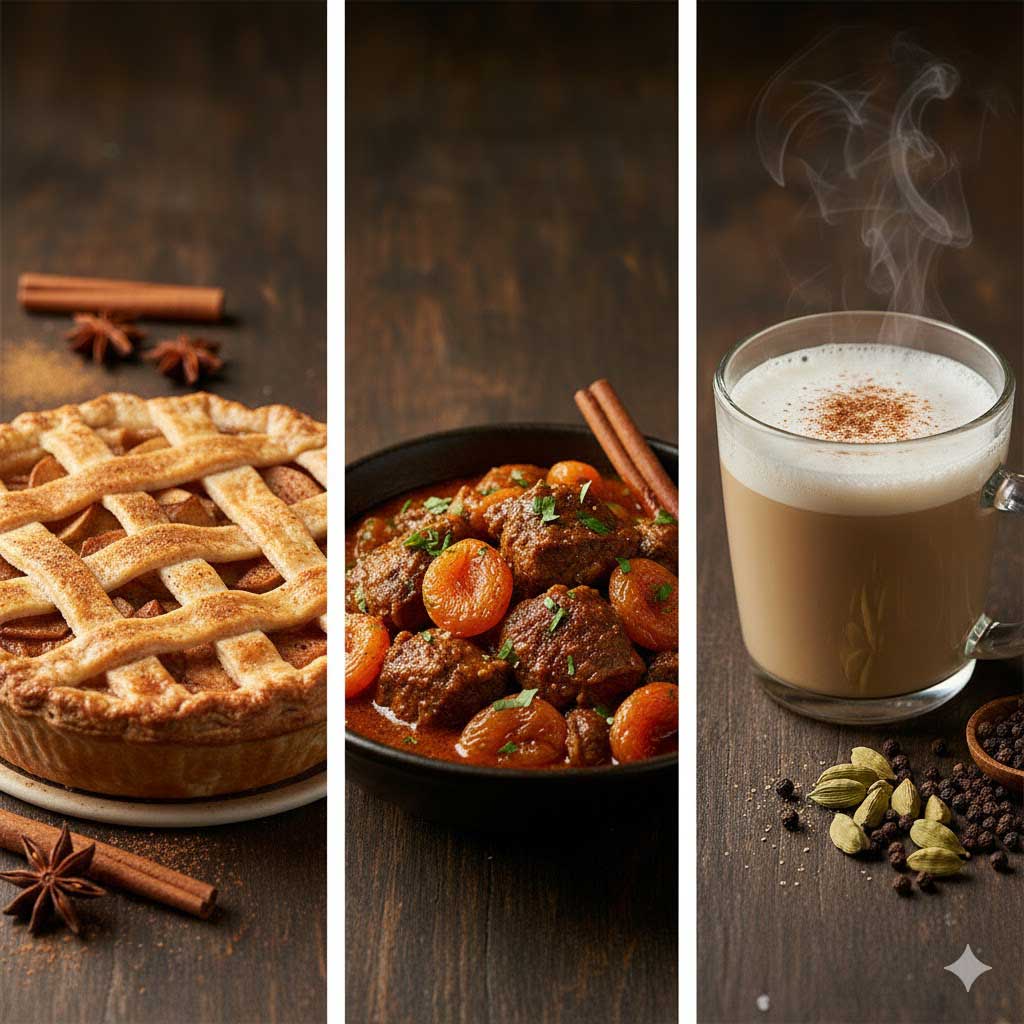
    Apple Pie (and most fruit desserts): This is perhaps cinnamon’s most iconic role in Western dishes. The warm, comforting aroma of cinnamon baked into an apple pie is synonymous with home and happiness. The spice doesn’t just add flavor; it enhances the apples’ natural sweetness, adds depth, and provides that characteristic “spiced” profile that transforms simple fruit into a beloved dessert. From crumbles to tarts, cinnamon is the fruit’s best friend.

    Moroccan Tagines (e.g., Lamb Tagine with Prunes): In Moroccan and North African cuisine, cinnamon takes a starring, often savory, role. In slow-cooked tagines, particularly those featuring lamb or chicken with dried fruits like prunes or apricots, cinnamon provides a foundational warmth and a delicate sweetness that perfectly complements the rich meat and savory spices like cumin and ginger. It’s this beautiful balance between sweet, savory, and aromatic that makes these tagines so uniquely delicious.

    Chai Tea: A quintessential beverage from the Indian subcontinent, “chai” simply means “tea,” but in the West, it refers to masala chai—spiced tea. Cinnamon is a crucial component of the masala (spice blend), usually alongside cardamom, ginger, cloves, and black peppercorns. It infuses the strong black tea with its comforting warmth and sweetness, creating a deeply aromatic and invigorating drink that has become popular worldwide. Without cinnamon, chai would lose much of its characteristic charm.

    From the essential pinch of salt that makes food sing, to the fiery kick of pepper that awakens the palate, and the sweet embrace of cinnamon that transports us to distant lands, these spices are true culinary superstars. Their stories are woven into the fabric of our meals, reminding us that sometimes, the simplest ingredients have the most profound impact.
    My other articles are listed here.

  • Beyond the Shaker: When 3 Great Spices Speak in Code

    We’ve journeyed through the ancient histories of salt and pepper, delved into the aromatic mysteries of cinnamon, and celebrated their starring roles in iconic dishes. But what happens when these culinary companions leave the kitchen and enter the realm of everyday language? When they shed their literal meanings and take on entirely new lives as metaphors, idioms, and slang?

    It turns out our beloved spices are not just flavor enhancers; they’re linguistic shapeshifters, adding zest and color to our conversations, sometimes subtly, sometimes with a surprising kick. From describing emotions to indicating financial worth, salt, pepper, and other spices have infiltrated our vocabulary, proving their influence extends far beyond the plate.

    “Worth Your Salt”: From Roman Rations to Worthy Contributions

    Let’s start with our most fundamental seasoning: salt. As we learned, the word “salary” is derived from the Roman salarium, the payment given to soldiers to buy salt. This direct link to wages and essential value gave rise to the enduring idiom, worth your salt.”

    When we say someone “is worth their salt,” we mean they are competent, deserving of their pay, and contribute meaningfully to their job or task. Conversely, someone “not worth their salt” is considered lazy, ineffective, or unworthy of their position. This phrase perfectly encapsulates salt’s ancient status as a vital commodity, its presence equating to sustenance and value, its absence to deprivation and worthlessness. It’s a linguistic echo of a time when salt was literally currency, and proving your worth meant proving your ability to earn—and afford—this precious mineral.

    Beyond the workplace, “salt of the earth” describes a person who is honest, humble, and fundamentally good. This evokes the purity and essential nature of salt, suggesting that such individuals are the unpretentious, grounding force of society. And, of course, the humorous notion of taking something “with a grain of salt” advises caution and skepticism, reminding us not to accept everything at face value, much like a tiny pinch can temper a strong flavor.

    A three-panel image on a wooden background. The left panel shows a Roman soldier in armor holding a bag, with a speech bubble saying "WORTH HIS SALT!". Gold coins and a pile of salt are at his feet. The middle panel features an elderly farmer in overalls holding a bowl of salt in a wheat field, with a speech bubble saying "SALT OF THE EARTH". The right panel shows a woman looking through a magnifying glass at a pinch of salt in her hand, with a speech bubble saying "TAKE IT WITH A GRAIN OF SALT!". it represent how spices can be used in language.

    “Peppering” Your Speech: A Little Kick of Intensity

    Black pepper, with its sharp, pungent kick, translates into language that suggests intensity, distribution, or even aggression.

    To “pepper” someone with questions, for example, means to ask them many rapid-fire questions, often in quick succession, much like a chef would rapidly grind pepper over a dish. It implies a concentrated, almost overwhelming barrage. Similarly, an object or surface might be “peppered with holes,” meaning it’s covered with many small holes, as if from a shot. This conveys a sense of thorough, widespread distribution.

    While not as common, the phrase “hot as pepper” is a direct descriptor of high heat or temper, leveraging pepper’s inherent spiciness. In some older contexts, “pepper” could even be used to describe someone with a fiery personality or a sharp wit. The essence of pepper in language is always about adding a certain energetic punch, a distributed intensity, or a noticeable, often sharp, characteristic.

    A three-panel image on a wooden background. The left panel shows a journalist "peppering" a man with questions, depicted as peppercorns flying from his mouth, with "WHY?" speech bubbles. The middle panel shows a weathered target practice board with multiple bullet holes, captioned "PEPPERED WITH HOLES". The right panel features a smiling woman with vibrant red hair styled with green and red chili peppers, with a title "SPICY PERSONALITY" and flames representing well how spices are used in language.

    “Spicing Things Up”: Adding Excitement to Life

    When we move to “spices” in general, the linguistic possibilities truly explode. The most common phrase, to “spice things up,” is universally understood as adding excitement, variety, or a thrill to an otherwise dull or routine situation. Whether it’s spicing up a relationship, a conversation, or a presentation, the analogy is clear: just as spices transform bland food into a vibrant feast, they can transform monotony into vibrancy.

    This phrase beautifully captures the collective power of spices to stimulate the senses, ignite passion, and infuse life with flavor. It highlights their role not just as mere ingredients, but as catalysts for transformation.

    We also have expressions like “variety is the spice of life,” emphasizing that diversity and change are what make existence interesting and enjoyable. This proverb recognizes spices as the embodiment of invigorating difference. Someone with a “spicy personality” is often seen as lively, bold, and perhaps a little bit mischievous or risqué, echoing the bold flavors and sometimes surprising heat of exotic spices.

    Beyond the Usual Suspects: A Global Flavor of Words

    Other individual spices also leave their mark on our language:

    • Ginger: To have “ginger” or “ginger up” something means to add energy, liveliness, or enthusiasm. “Ginger ale” itself got its name from its invigorating, slightly spicy kick. A “ginger-haired” person has vibrant, fiery red hair, reminiscent of the root.
    • Chilli/Chili: Beyond literal spiciness, “chili” can describe something intense, hot, or daring. A “chili recipe” for success suggests something bold and impactful.
    • Vanilla: While a spice of incredible depth, “vanilla” in English slang often refers to something plain, unadventurous, or conventional, precisely because its flavor is so universally popular and non-threatening. To describe something as “vanilla” is to say it lacks excitement or edge. This is an ironic twist, given how complex and valuable real vanilla bean is!

    From the foundational value of salt to the pungent punch of pepper and the collective zest of “spices” generally, these kitchen staples have seasoned our lexicon as much as they have seasoned our food. They provide vivid imagery and concise expressions that allow us to communicate nuances of character, situation, and emotion. The next time you reach for the salt shaker or a pepper mill, remember that you’re not just adding flavor to your meal; you’re engaging with a deep linguistic history where these everyday ingredients have always been, in one way or another, utterly priceless.


    My other articles are listed here.

  • Cinnamons: The Sweet Embrace of History

    Close your eyes for a moment and take a deep breath. What do you smell? Perhaps a warm apple pie, a spiced latte on a chilly morning, or the comforting aroma of a festive holiday treat. That unmistakable scent, both sweet and subtly fiery, belongs to cinnamons, one of the oldest and most cherished spices in human history.

    Far from being just a sprinkle on your oatmeal, cinnamon is a spice steeped in myth, medicine, and mercantile might. Its fragrant bark has influenced empires, inspired daring voyages, and continues to enchant palates across the globe, proving that some of the greatest treasures come wrapped not in gold, but in a delicate, curled stick.

    A Bark of Legends and Lore

    Cinnamon’s story begins not in the kitchen, but in ancient lands shrouded in mystery. For centuries, its true origin was a closely guarded secret, allowing Arab traders to maintain a lucrative monopoly. They spun elaborate tales of giant birds guarding cinnamons nests in unknown lands, or mythical beasts defending precious groves, all to deter competitors and justify its exorbitant price. This air of exoticism only enhanced its value.

    Ancient Egyptians used cinnamons not for culinary delight, but as a crucial ingredient in embalming rituals, a testament to its preservative qualities and revered status. In biblical times, it was mentioned as an anointing oil and a fragrant perfume. The Romans, despite its high cost, burned cinnamons at funerals, believing its sweet smoke would ward off evil spirits and offer a fitting tribute to the gods.

    Its journey to the Western world was long and perilous, traversing the ancient spice routes from Ceylon (modern-day Sri Lanka) and other parts of Southeast Asia, through India, the Middle East, and eventually to Europe. By the Middle Ages, cinnamons was a highly prized luxury item, alongside pepper and cloves, often reserved for royalty and the very wealthy, who used it to flavor wines, meats, and confections, as well as for its perceived medicinal properties. The quest for direct access to these spice-rich lands, bypassing expensive intermediaries, became another driving force behind European exploration, echoing pepper’s narrative but with a sweeter, more aromatic ambition.

    An ancient bustling harbor scene under a warm, hazy sky. In the foreground, men in traditional attire sort and trade cinnamons sticks in crates, surrounded by sacks overflowing with colorful spices. A large wooden sailing ship, its deck also laden with spices, is docked in the background, with other smaller boats and distant buildings completing the vibrant market setting. A banner at the top reads "CINNAMOM: A MYSTERY."

    Ceylon vs. Cassia: Cinnamons Showdown

    While many of us grab a jar simply labeled “cinnamons,” there are primarily two main types that dominate the market, each with its distinct characteristics and culinary applications: Ceylon cinnamon and Cassia cinnamon.

    Ceylon Cinnamon (Cinnamomum verum or “true cinnamon”): Often referred to as “true cinnamon,” Ceylon cinnamon originates primarily from Sri Lanka. It is characterized by its delicate, almost papery thin layers that roll into a soft, easily crumbled quill. Its flavor is subtle, sweet, and highly aromatic, with complex notes that are less spicy and more nuanced. It’s the preferred choice for desserts, baked goods, and dishes where a refined cinnamon flavor is desired. Because it’s less commonly available and more labor-intensive to produce, it often commands a higher price.

    Cassia Cinnamon (Cinnamomum cassia): This is the more common variety found in most grocery stores, originating from China, Vietnam (Saigon cinnamon), and Indonesia. Cassia bark is thicker, harder, and coarser, forming a single, sturdy scroll rather than delicate layers. Its flavor is much stronger, spicier, and more pungent, with a noticeable bite. It contains higher levels of coumarin, a natural chemical that can be harmful in very large doses, though typical culinary use is generally considered safe. Cassia is the “cinnamon” flavor most people are familiar with, often used in savory dishes, robust baked goods, and in blends like Chinese five-spice powder.

    Understanding the difference can truly elevate your cooking, allowing you to choose the right cinnamon for the right dish—the delicate sweetness of Ceylon for a crème brûlée, or the bold warmth of Cassia for a hearty beef stew.

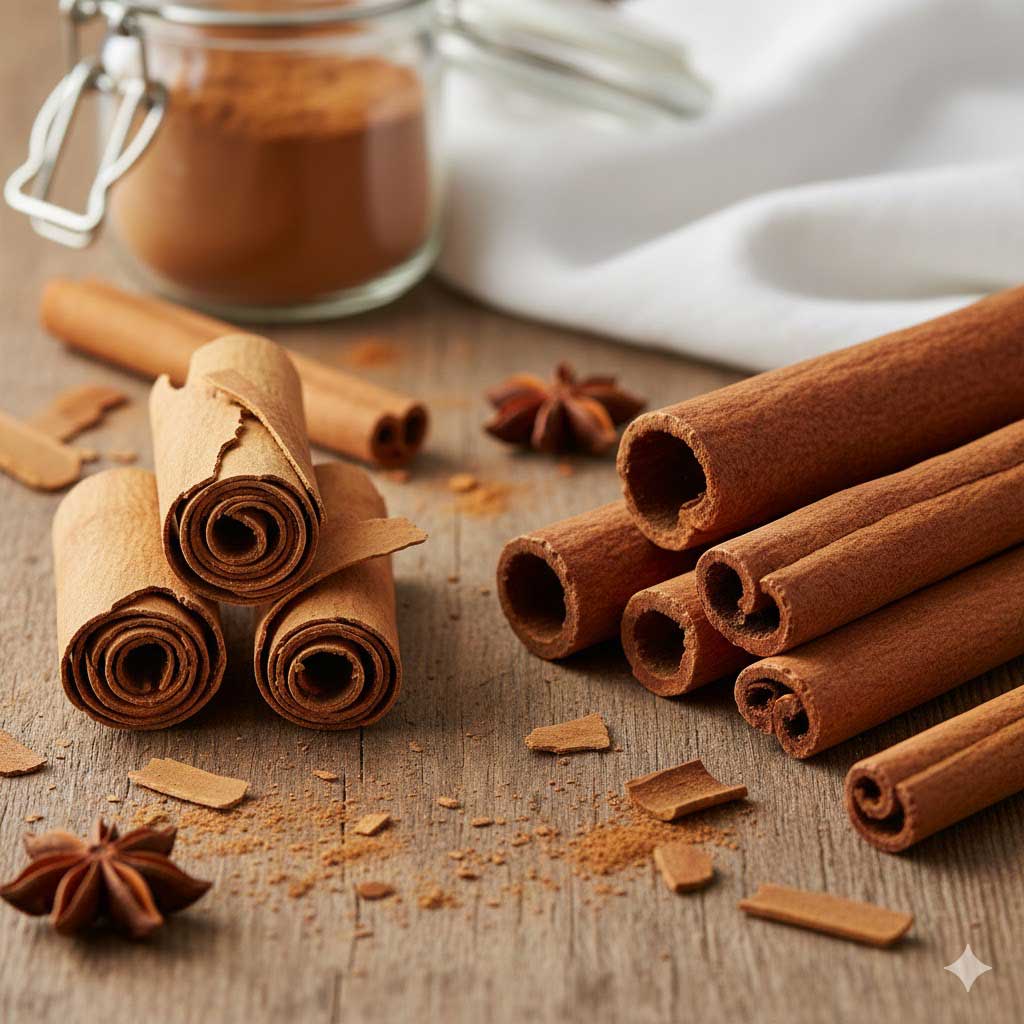
    A close-up shot on a rustic wooden surface showcases two distinct types of cinnamon sticks. On the left, delicate, multi-layered Ceylon cinnamon quills are visible, with some broken flakes and powder. On the right, thicker, robust Cassia cinnamon sticks are grouped. In the background, a jar of ground cinnamon and a white cloth are softly blurred. Star anise pods and scattered cinnamon powder complete the aromatic scene.

    The Warmth of Wellness and Flavor

    Beyond its captivating aroma, this condiment has long been revered for its potential health benefits. In ancient herbal medicine, it was used to aid digestion, reduce inflammation, and even as a remedy for colds and flu. Modern science is beginning to catch up, with studies exploring its antioxidant properties and potential role in blood sugar regulation. It’s thought to improve insulin sensitivity and lower blood glucose levels, making it a subject of interest for those managing diabetes.

    In the culinary realm, the holiday spice is a chameleon. It effortlessly bridges the gap between sweet and savory. In sweet applications, it’s the star of apple pies, cinnamons rolls, rice puddings, and pumpkin spice lattes. Its warmth enhances fruit, balances sweetness, and adds a comforting depth.

    On the savory side, cinnamon shines in cuisines across the globe. It’s a foundational spice in many Indian curries and masalas, often toasted to release its deep, earthy notes. In Middle Eastern and North African tagines and stews, it contributes a subtle sweetness and aromatic complexity to lamb, chicken, and vegetable dishes. Even in Mexican mole sauces, cinnamons plays a crucial, balancing role, demonstrating its incredible versatility. It proves that a “sweet” spice can be a powerful secret weapon in the savory kitchen.

    More Than Just a Twist

    This seasoning’s allure extends beyond the plate. Its essential oil is a popular component in aromatherapy, believed to be stimulating, uplifting, and even an aphrodisiac. It’s widely used in perfumes, potpourris, and candles, filling homes with its inviting fragrance.

    Historically, its antimicrobial properties were used to preserve food, even before its active compounds were fully understood. Today, it’s explored as a natural pest deterrent in gardening, with its strong scent believed to repel certain insects and fungi. From its origins as a mysterious bark guarded by mythical beasts to its role as a global flavor enhancer and potential wellness aid, cinnamons continue to weave its enchanting spell. It reminds us that some of the most profound impacts on our lives come from the simplest, most aromatic gifts of nature.

    My other articles are listed here.

  • The King of Spices: Black Pepper’s Fiery Reign

    You probably use it every day without a second thought. It sits beside its white companion, salt, a steadfast duo on nearly every dining table globally. But this unassuming little berry, crushed and scattered with a flick of the wrist, is no mere sidekick. Black pepper, the “King of Spices,” has a history as rich, complex, and sometimes brutal as any monarch’s reign.

    From ancient trade wars to modern gastronomy, Piper nigrum has shaped economies, fueled exploration, and tantalized taste buds for millennia. Far more than just a seasoning, black pepper is a culinary cornerstone, a historical artifact, and a surprisingly versatile ingredient that continues to command respect.

    A Kernel of Empires

    Long before Marco Polo set sail or Columbus bumped into the Americas, black pepper was already a highly sought-after commodity. Originating from the Malabar Coast of Kerala in southwestern India, this climbing vine’s berries were a crucial component of ancient trade. Roman texts mention this seasoning frequently, and it was so valued that Alaric the Goth demanded 3,000 pounds of it as part of Rome’s ransom in 410 AD.

    During the Middle Ages, pepper’s importance only grew. Along with other exotic spices, it was a luxury item, a status symbol for the wealthy, and a potent preservative. Control over the spice trade routes, particularly those bringing the condiment from the East to Europe, meant immense power and wealth. Venice and Genoa grew rich as intermediaries, while Arab traders maintained a tight grip on the source.

    This quest for direct access to the pepper-producing lands was a primary driver for the Age of Exploration. Vasco da Gama’s historic voyage around Africa to Calicut, India, in 1498 wasn’t just about discovering new lands; it was fundamentally about breaking the Arab and Venetian monopoly on the spice trade. The Portuguese, Dutch, and later the British and French, fought fiercely over control of the pepper-rich regions, their navies clashing over what amounted to tiny dried berries. The history of pepper is truly a history of empires.

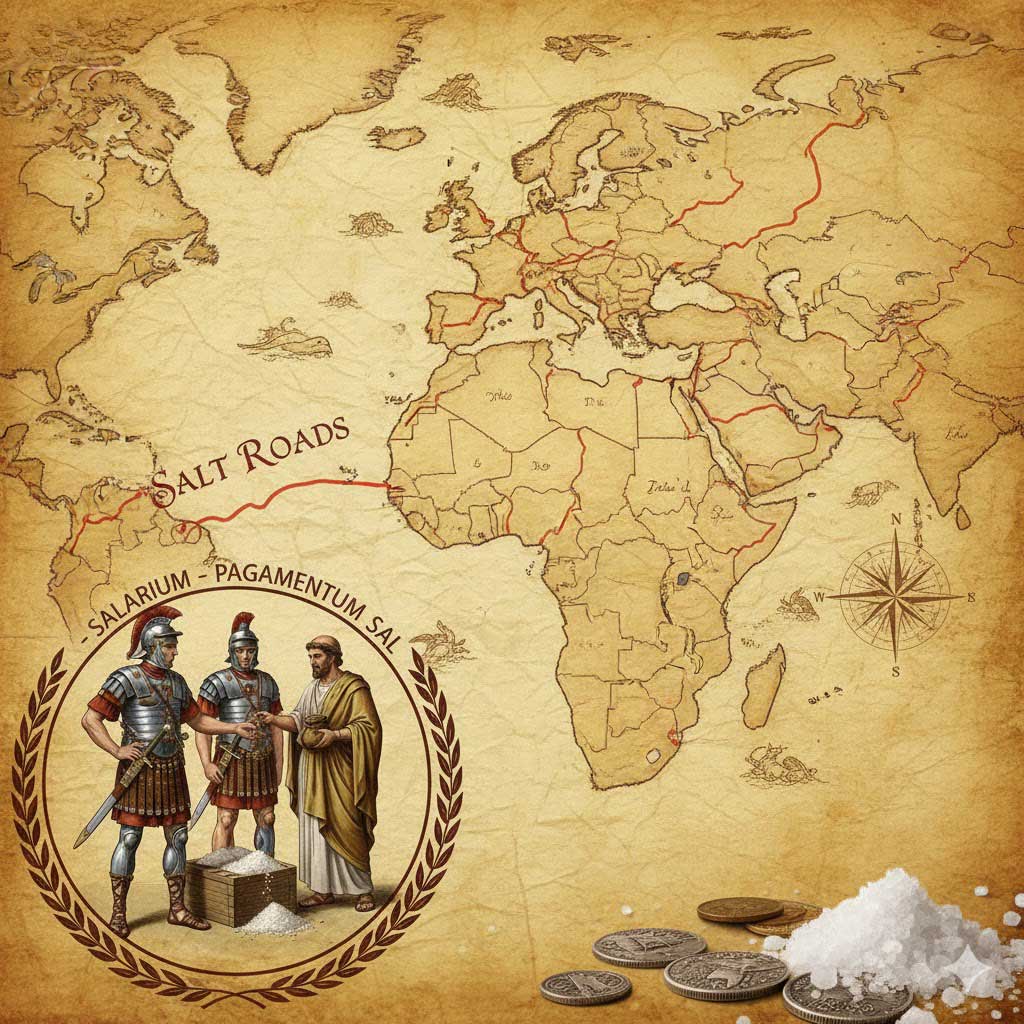
    An old, crumpled map in sepia tones depicts Africa, Europe, and Asia, with a large 15th-century sailing ship in the ocean. The ship is overflowing with giant black pepper, some spilling into the water. A snake-like sea monster is visible to the left, and a compass rose is in the bottom left corner. The map is labeled with "Salt Roads" and "Salarium - Pagamentum Sal."

    More Than Just “Black”: The Peppercorn Family

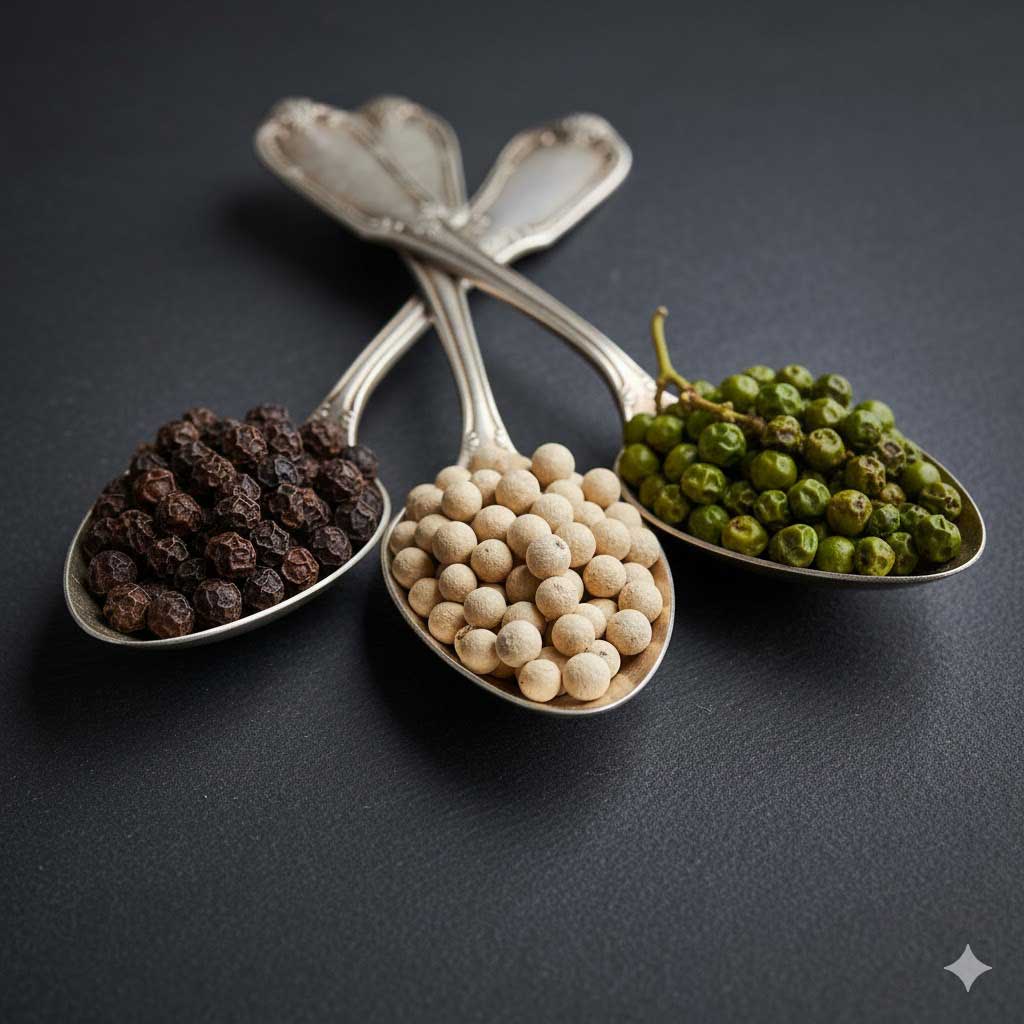
    When we say “pepper,” most people immediately think of the familiar black variety. However, like many noble families, the peppercorn lineage is more diverse than it first appears. All true peppers—black, white, and green—come from the same Piper nigrum plant, but their differences arise from when and how they are harvested and processed.

    Black Peppercorns: These are the unripe, green berries that are cooked briefly in hot water (which bursts their cell walls), then dried in the sun. The sun-drying process causes them to shrivel and blacken, developing their characteristic pungent, earthy, and slightly spicy flavor. The heat comes from piperine, a chemical compound found in the fruit and seed.

    Green Peppercorns: These are also unripe berries, but they are either freeze-dried or preserved in brine or vinegar. This process retains their vibrant green color and a fresh, milder, more aromatic flavor compared to black pepper. They are often found in French cuisine, particularly in steak au poivre. To see more about the green variety, check this website.

    White Peppercorns: These are the mature, ripe berries. After harvesting, they are soaked in water, which allows the outer layer of the fruit to ferment and soften. This outer layer is then rubbed off, revealing the lighter-colored inner seed. White pepper has a sharper, sometimes muskier aroma and a more direct heat, often preferred in lighter-colored dishes where black flecks would be visually unappealing (like mashed potatoes or cream sauces).

    It’s important to distinguish these true peppers from “false peppers” like pink peppercorns (from the Brazilian pepper tree) or Sichuan peppercorns (from the prickly ash tree), which offer different flavor profiles and delightful tingling sensations but are not botanically related to Piper nigrum.

    The Science of Spice

    So, what makes the black pungent berry tick? Its signature heat and aroma come primarily from an alkaloid called piperine. Unlike capsaicin in chilies, which targets pain receptors and gives a fiery burn, piperine stimulates heat and pain receptors in a more subtle, complex way. It creates a warm, aromatic pungency that is distinct and invigorating.

    Beyond its flavor, the aromatic berry also plays a fascinating role in health. It contains antioxidants and has anti-inflammatory properties. Most notably, piperine is known to enhance the bioavailability of certain nutrients and drugs, including curcumin (found in turmeric). This is why you often see this spice paired with turmeric in supplements and traditional medicine—this spice helps your body absorb more of the good stuff.

    In the kitchen,the black condiment is a universal enhancer. It does more than just add “heat”; it brightens flavors, adds depth, and creates complexity. The freshly ground ones is almost always superior to pre-ground pepper, which quickly loses its volatile aromatic compounds. The act of grinding releases those oils, creating a burst of fresh aroma and flavor that can elevate almost any dish, from a simple omelet to a sophisticated sauce.

    Beyond the Shaker

    While it is a staple for seasoning almost anything, this one has some surprising roles outside the dinner table. In traditional medicine, it has been used to treat digestive issues, coughs, and colds. Its stimulating properties were even thought to aid concentration.

    In more unexpected applications, some gardeners use a sprinkle of black pepper as a natural deterrent for pests like ants. Its strong aroma is believed to confuse and repel them, offering an organic alternative to chemical pesticides. And of course, its pungent scent is often a component in various aromatherapy blends, believed to be invigorating and stimulating.

    From being a currency that defined empires to its place as a humble grinder on our tables, black pepper’s journey is a testament to the enduring power of a single, small spice. It reminds us that sometimes, the greatest influence comes in the smallest packages, igniting our taste buds and connecting us to a history far spicier than we often realize.

    My other articles are listed here.
  • Worth Your Salt: The Rock That Changed the World

    It is the only rock we eat. It is in your blood, your sweat, and quite literally in your tears. It has toppled empires, sparked revolutions, and is likely sitting on your kitchen table right now in a cardboard cylinder or a fancy wooden grinder. We are talking, of course, about salt.

    For something so ubiquitous—often carelessly tossed over a shoulder to ward off bad luck or sprinkled onto soggy fries—salt holds a secret power. It is not merely a condiment; it is a biological necessity and a historical juggernaut. If you strip away the spices, the herbs, and the sauces from the culinary world, salt is the one element you cannot lose. It is the difference between a meal that sings and a meal that sleeps. But how did this humble mineral manage to take over the world?

    The Salary of Soldiers

    To understand the gravity of salt, we have to rewind a few thousand years. Before the age of refrigeration, salt was the only way to keep food from rotting. If you had salt, you could preserve meat and fish for the long winter or for long voyages. If you didn’t, you starved. This made salt incredibly valuable—sometimes literally worth its weight in gold.

    The impact on our language is undeniable. The word “salary” comes from the Latin salarium, which was a specific allowance given to Roman soldiers to purchase salt. It was an essential part of their livelihood. If a soldier was lazy or incompetent, he was deemed “not worth his salt”—a phrase we still use today, likely without realizing we are referencing the payroll of a legionnaire from 50 B.C.

    Trade routes were forged not just for silk or spices, but specifically for rocks with sodium chloride. The Via Salaria in Italy was the “Salt Road” used to move the mineral from the coast to Rome. Cities like Salzburg (“Salt Fortress”) in Austria were built entirely on the wealth extracted from nearby salt mines. It wasn’t just a seasoning; it was the currency of survival.

    The Crystal Spectrum

    Fast forward to the modern kitchen, and we are spoiled for choice. A century ago, you likely had one option: a white, iodized powder that flowed freely in humid weather thanks to anti-caking agents. Today, the salt aisle is a spectrum of textures and colors, and knowing the difference can change your cooking game entirely.

    First, there is the workhorse: Table Salt. It’s dense, uniformly shaped, and very salty by volume. It dissolves slowly and is best used for pasta water or baking, where it disappears into the batter. However, because of its density, it is easy to over-salt a dish if you aren’t careful.

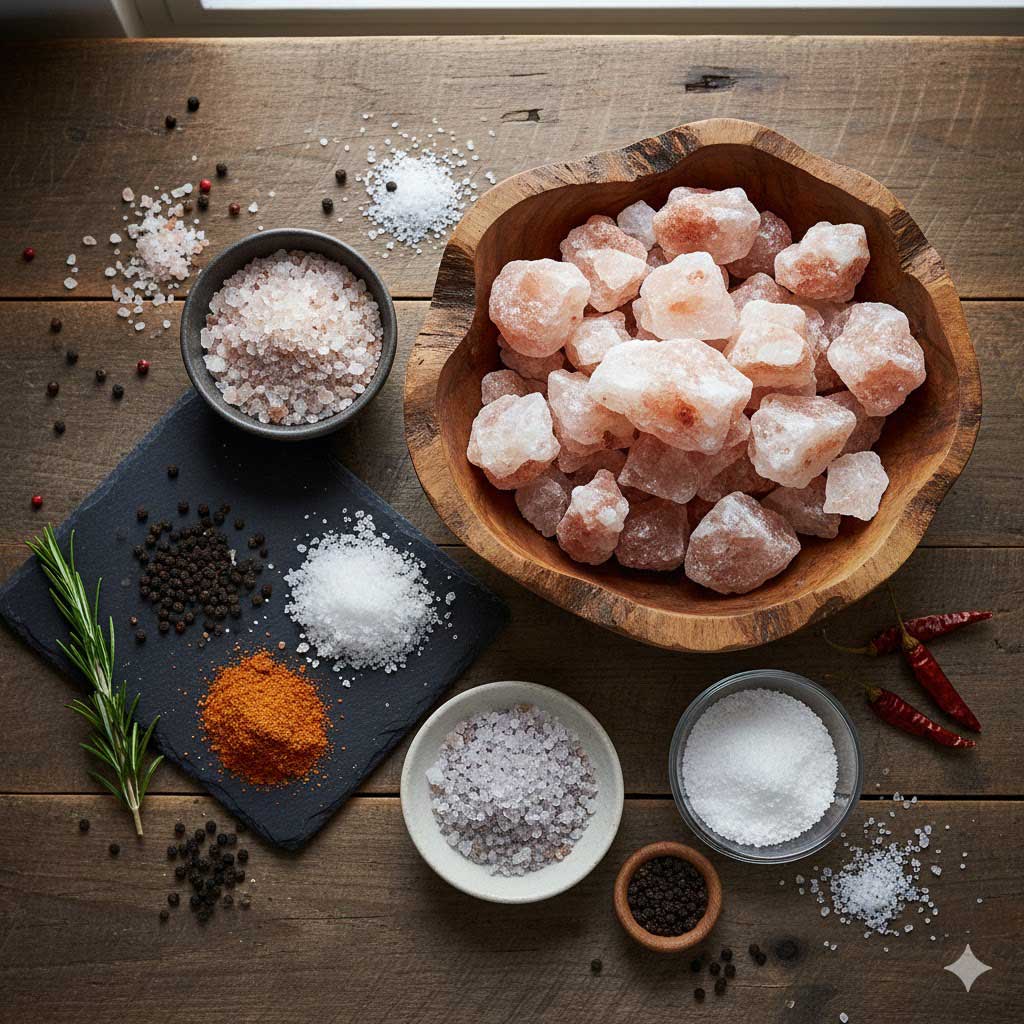
    Then, we have the chef’s darling: Kosher Salt. The name comes from the process of “koshering” meat (drawing out the blood), not necessarily because the salt itself is holy. Its grains are flaky, coarse and can be seen as big rocks. Why do chefs love it? Control. You can pick up a pinch of kosher salt with your fingers and feel exactly how much you are adding. It doesn’t bounce off the food; it clings.

    Finally, there are the Finishing Salts, like Fleur de Sel or Maldon. These are the diamonds of the salt world. Harvested by hand from the surface of evaporating seawater, these little rocks retain moisture and minerals from the ocean. You never cook with these—that would be a waste of money. Instead, you sprinkle them on top of a steak or a chocolate chip cookie right before serving. The crunch creates a textural explosion, sending little zaps of salinity that contrast beautifully with the food.

    A rustic wooden surface is covered with various types of salt, peppercorns, and spices. A large wooden bowl holds chunky pink Himalayan salt rocks. Smaller bowls and piles contain pink salt rocks, white sea salt, grey salt, and fine white table salt. A black slate tile displays black peppercorns, orange paprika, and a sprig of rosemary. Dried red chilies and loose spices are scattered around the arrangement.

    The Science of Savor

    So, what is actually happening when we salt our food? It’s not just about making things taste “salty.” This rock is a flavor potentiator.

    At a chemical level, salt suppresses bitterness. This is why some people put a pinch of salt in cheap coffee or on grapefruit. When you suppress the bitter notes, the sweet and sour notes are allowed to shine through more clearly. This is also why salt is mandatory in baking. A brownie without salt tastes flat and overly sugary; add salt, and the chocolate flavor suddenly becomes deep and complex.

    Salt also plays a crucial role in texture. If you are grilling a steak, salt rocks does two things. First, it draws moisture to the surface through osmosis. This moisture dissolves the salt, creating a brine that is eventually reabsorbed into the meat, seasoning it from the inside out (a process that takes about 40 minutes). Second, that surface moisture helps create a better sear when the meat hits the hot pan.

    However, timing is everything. Salt your scrambled eggs too early, and they might turn watery and gray. Salt your mushrooms at the start of sautéing, and they will steam in their own juices rather than brown. Cooking is essentially a chemistry experiment, and salt is your primary reagent.

    Respect the Rock

    It is easy to view salt as the villain of the modern diet, associated with high blood pressure and processed foods. While it is true that we consume far too much hidden sodium in pre-packaged meals, the salty rock used correctly in home cooking is rarely the enemy. It is a nutrient we die without—sodium is required for nerve impulses and muscle contractions.

    So, the next time you reach for the shaker, take a moment to appreciate what you are holding. It’s a geologic rocky relic, a preserver of history, and the single most important tool in your culinary arsenal. Don’t just sprinkle it blindly. Taste, adjust, and let the rock do its work.

    My other articles are listed here.